Doubt

Doubt

Jesus immediately reached out his hand and took hold of him, saying to him, “O you of little faith, why did you doubt?” Matthew 14:31 ESV

But let him ask in faith, with no doubting, for the one who doubts is like a wave of the sea that is driven and tossed by the wind. James 1:6 ESV

Trust in the Lord with all your heart, and do not lean on your own understanding. In all your ways acknowledge him, and he will make straight your paths. Be not wise in your own eyes; fear the Lord, and turn away from evil. It will be healing to your flesh and refreshment to your bones. Proverbs 3:5-8 ESV

And Jesus answered them, “Truly, I say to you, if you have faith and do not doubt, you will not only do what has been done to the fig tree, but even if you say to this mountain, ‘Be taken up and thrown into the sea,’ it will happen. Matthew 21:21

Truly, I say to you, whoever says to this mountain, ‘Be taken up and thrown into the sea,’ and does not doubt in his heart, but believes that what he says will come to pass, it will be done for him. Mark 11:23 ESV

Angels

For he will command his angels concerning you to guard you in all your ways. Psalm 91:11 ESV


Do not neglect to show hospitality to strangers, for thereby some have entertained angels unawares. Hebrews 13:2 ESV


Are they not all ministering spirits sent out to serve for the sake of those who are to inherit salvation? Hebrews 1:14 ESV


The angel of the Lord encamps around those who fear him, and delivers them. Psalm 34:7 ESV

The Vision of Jesus


Dear Heavenly Father, please be our guide through this study of the Seven Churches in Revelation. Show us Your meaning not one skewed with our thoughts and experience, but only Your thoughts. In Jesus Name Amen.

Sitting in a jail cell gives one extra time to think, ponder life and pray. John was in Patmos serving time for unlawfully sharing the message of Jesus Christ in Ephesus. The Jewish elite, because of Roman persecution, had thrown Christians under the bus to Domitian, a Roman Emperor. The elite said because the Christians taught the reality of who Jesus was that He came to earth to save us all, and was raised after three days from the dead. It would cause dire consequences to the Roman Empire. At this time if this message was shared it could be, if permitted, jail time and even death. In a time of meditation and prayer, in the “Spirit”, John heard a loud voice behind him. Picture that you are in a room all by yourself all is silent and all of a sudden “WRITE WHAT YOU SEE”, super loud. Do you think he jumped? Maybe a scream? I know what I would have done, my head would hit the ceiling, it would have been a good thing it was Jesus Christ because I would of probably needed a head wound healed.

Now after taking a moment to regain a little composure, if at all, he turns around to someone standing there surrounded by lampstands. Looking like royalty, white hair, flames in His eyes, and when He spoke it was deafening. He was holding seven stars in His hand, when He would speak out of His would came a double edge sword, and the light coming off of Him was bright enough John could not stand to look at Him for too long. You know someone you would expect to see in a prison cell. John says “I feel at His feet as though I was dead”, immediately a hand of comfort reaches out and says” Fear not, I am the first and the last, and the living one. I died, and behold I am alive forevermore”. He lets John know I am Jesus, I am here, and everything is all right. My children need to hear some things and I need you to write them down and deliver it to them.

In this journey through the vision of the seven churches of Revelation we will see the love that our God has for us. You will see that with fulfilling the prophesy of coming to earth, being crucified, and raised from the dead three days later; did not mean that He then ascended to Heaven put His feet up sat back on His throne and said “I am good now take care of it”. No; He came down once more and said hey, I love you and you did not hear what I said, you need to take care of this our we will not be able to see each other. The message that He left to the Seven Churches still resonates today, in some aspects more now then back when the Revelation was given to John. We will see how some would twist the word for personal gain; others would get to comfortable and think they could do it better then God. Groups that would try to justify their sin through the teaching of Christ, and a few that use deceitfulness to try and destroy what Jesus had done for them. With the warnings and acknowledgments that are given in these seven letters we can see that if we apply them to our lives it will make our walk with Christ even closer then you could have ever imagined.

Vision of the Son of Man

I, John, your brother and partner in the tribulation and the kingdom and the patient endurance that are in Jesus, was on the island called Patmos on account of the word of God and the testimony of Jesus. I was in the Spirit on the Lord’s Day, and I heard behind me a loud voice like a trumpet saying, “Write what you see in a book and send it to the seven churches, to Ephesus and to Smyrna and to Pergamum and to Thyatira and to Sardis and to Philadelphia and to Laodicea.”

Then I turned to see the voice that was speaking to me, and on turning I saw seven golden lampstands, and in the midst of the lampstands one like a son of man, clothed with a long robe and with a golden sash around his chest. The hairs of his head were white, like white wool, like snow. His eyes were like a flame of fire, his feet were like burnished bronze, refined in a furnace, and his voice was like the roar of many waters. In his right hand he held seven stars, from his mouth came a sharp two-edged sword, and his face was like the sun shining in full strength.

When I saw him, I fell at his feet as though dead. But he laid his right hand on me, saying, “Fear not, I am the first and the last, and the living one. I died, and behold I am alive forevermore, and I have the keys of Death and Hades. Write therefore the things that you have seen those that are and those that are to take place after this. As for the mystery of the seven stars that you saw in my right hand, and the seven golden lampstands, the seven stars are the angels of the seven churches, and the seven lampstands are the seven churches. Revelation 1:9-20 (ESV)


Laodicea

It’s Laodicea

A city of Asia Minor situated in the Lycos valley in the province of Phrygia, and the home of one of the Seven Churches of Revelation. Distinguished from several other cities of that name by the appellation Ad Lycum, it was founded by Antiochus II (261-246 BC) of Syria, who named it for his wife Laodike, and who populated it with Syrians and with Jews who were transplanted from Babylonia to the cities of Phrygia and Lydia.

And to the angel of the church in Laodicea write: The words of the Amen, the faithful and true witness, the beginning of God’s creation. “I know your works: you are neither cold nor hot. Would that you were either cold or hot! So, because you are lukewarm, and neither hot nor cold, I will spit you out of my mouth. For you say, I am rich, I have prospered, and I need nothing, not realizing that you are wretched, pitiable, poor, blind, and naked. I counsel you to buy from me gold refined by fire, so that you may be rich, and white garments so that you may clothe yourself and the shame of your nakedness may not be seen, and salve to anoint your eyes, so that you may see. Those whom I love, I reprove and discipline, so be zealous and repent. Behold, I stand at the door and knock. If anyone hears my voice and opens the door, I will come in to him and eat with him, and he with me. The one who conquers, I will grant him to sit with me on my throne, as I also conquered and sat down with my Father on his throne. He who has an ear, let him hear what the Spirit says to the churches.” Revelation 3:14-22 ESV

Though Laodicea stood on the great highway at the junction of several important routes, it was a place of little consequence until the Roman province of Asia was formed in 190 BC. It then suddenly became a great and wealthy center of industry, famous specially for the fine black wool of its sheep and for the Phrygian powder for the eyes, which was manufactured there (compare Rev_3:18). In the vicinity was the temple of Men Karou and a renowned school of medicine. In the year 60 AD, the city was almost entirely destroyed by an earthquake, but so wealthy were its citizens that they rejected the offered aid of Rome, and quickly rebuilt it at their own expense (compare Rev_3:17). It was a city of great wealth, with extensive banking operations (compare Rev_3:18). Little is known of the early history of Christianity there; Timothy, Mark and Epaphras (Col_1:7) seem to have been the first to introduce it. However, Laodicea was early the chief bishopric of Phrygia, and about 166 AD Sagaris, its bishop, was martyred. In 1071 the city was taken by the Seljuks; in 1119 it was recovered to the Christians by John Comnenus, and in the 13th century it fell finally into the hands of the Turks.

Getting to Know Him

Do you want eternal life? Do you want to enter heaven through the only guide that can help you navigate your way there? To enter His home, get to know Him better, and make Him your Lord and Savior CLICK HERE…..

Citations:

Esword

“Sword: Free Bible Study for the PC.” Matthew Henry’s Concise Commentary , e-sword.net/.

Bible Gateway

 “BibleGateway.” BibleGateway.com: A Searchable Online Bible in over 150 Versions and 50 Languages., http://www.biblegateway.com/‎.

ESV

The Holy Bible, English Standard Version. ESV® Text Edition: 2016. Copyright © 2001 by Crossway Bibles, a publishing ministry of Good News Publishers.

© International Standard Bible Encyclopedia (ISBE)

Philadelphia

Philadelphia

was a city of Lydia, 28 miles from Sardis, in the valley of the Cogamis, a tributary of the Hermus, and conveniently situated for receiving the trade between the great central plateau of Asia Minor and Smyrna. The district known as Katakekaumene (‘Burnt Region’), because of its volcanic character, rises immediately to the N.E. of Philadelphia, and this was a great vine-producing region.
Philadelphia was founded and named by Attalus Philadelphus of Pergamos before B.C. 138. It was liable to serious earthquakes, but remained an important centre of the Roman province of Asia, receiving the name of Neo-Cæsarea from Tiberius, and, later on, the honour of the Neocorate (i.e. the wardenship of the temple for Emperor-worship). There is no record of the beginning of the Church at Philadelphia, but in the Apocalypse it is one of the seven churches to which, as heads of districts, special messages are sent. In its message (Rev 3:7-13 ESV)

“And to the angel of the church in Philadelphia write: The words of the holy one, the true one, who has the key of David, who opens and no one will shut, who shuts and no one opens. I know your works. Behold, I have set before you an open door, which no one is able to shut. I know that you have but little power, and yet you have kept my word and have not denied my name. Behold, I will make those of the synagogue of Satan who say that they are Jews and are not, but lie—behold, I will make them come and bow down before your feet, and they will learn that I have loved you. Because you have kept my word about patient endurance, I will keep you from the hour of trial that is coming on the whole world, to try those who dwell on the earth. I am coming soon. Hold fast what you have, so that no one may seize your crown. The one who conquers, I will make him a pillar in the temple of my God. Never shall he go out of it, and I will write on him the name of my God, and the name of the city of my God, the new Jerusalem, which comes down from my God out of heaven, and my own new name. He who has an ear, let him hear what the Spirit says to the churches.” Revelation 3:7-13 ESV

It is said to have ‘a little strength’ (which perhaps refers to its recent origin), and to have set before it ‘an open door,’ which seems to refer to the opportunities it had of spreading the gospel in the center of Asia Minor. In 3:9 ‘the synagogue of Satan which say they are Jews and are not’ must mean that the Jews of Philadelphia had been lax, and had conceded too much to Gentile ways. But the message contains no reproach against the Christians, although they are bidden to hold fast that which they have, and the promise to him that over cometh is that ‘I will write upon him the name of my God, and the name of the city of my God, the new Jerusalem, … and mine own new name.’ Doubtless there is a reference here, as in the message to Pergamus, to the new name taken at baptism, and apparently sometimes kept secret.
Philadelphia was the seat of a bishop, but was not a metropolis until about A.D. 1300, when the importance of Sardis had become less. In the 14th cent., when the Greek Empire retained nothing on the mainland of Asia except a strip of territory opposite Constantinople, Philadelphia still resisted the Ottoman arms, though far from the sea and almost forgotten by the Emperors. In the words of Gibbon (ch. lxiv): ‘Among the Greek colonies and churches of Asia, Philadelphia is still erect, a column in a scene of ruins: a pleasing example that the paths of honor and safety may sometimes be the same.’ The date of its final capture is uncertain—probably A.D. 1391. Its modern name is Alaşehir.

Getting to Know Him

Do you want eternal life? Do you want to enter heaven through the only guide that can help you navigate your way there? To enter His home, get to know Him better, and make Him your Lord and Savior CLICK HERE…..

Citations:

A.E. Hillard, Hastings Dictionary of the Bible

Get to know Jesus more…..

Sardis/Sart

Sardis

A city of Asia Minor , and capital of Lydia, situated about two miles to the south of the river Hermus, just below the range of Tmolus, on a spur of which its Acropolis was built. It was 60 miles northeast of Smyrna. It was the ancient residence of the kings of Lydia, among them Croesus, proverbial for his immense wealth. Cyrus is said to have taken $600,000,000 worth of treasure form the city when he captured it, B.C. 548.
Sardis was, in very early times, both from the extremely fertile character of the neighboring region, and from its convenient position, a commercial mart of importance. The art of dyeing wool is said to have been invented there. In the year 214 B.C., it was taken and sacked by the army of Antiochus, the Great. Afterward, it passed under the dominion of the kings of Pergamos. Its productive soil must always have continued a source of wealth; but its importance as a central mart appears to have diminished, from the time of the invasion of Asia by Alexander.
The massive temple of Cybele still bears witness, in its fragmentary remains, to the wealth and architectural skill of the people that raised it. On the north side of the Acropolis, overlooking the valley of the Hermus, is a theatre nearly 400 feet in diameter, attached to a stadium of about 1000 feet. There are still considerable remains of the ancient city at Sart. Travelers describe the appearance of the locality as that of complete solitude. The only passage in which it is mentioned in the Bible is Rev_3:1-6.

The ancient city was noted for its fruits and wool, and for its temple of the goddess Cybele, whose worship resembled that of Diana of Ephesus. Its wealth was also partly due to the gold which was found in the sand of the river Pactolus, and it was here that gold and silver coins were first struck. During the Roman period its coins formed a beautiful series, and are found in abundance by the peasants who till the surrounding fields. The ruins of the buildings which stood at the base of the hill have now been nearly buried by the dirt washed down from above. The hill upon which the acropolis stood measures 950 ft. high: the triple walls still surround it. The more imposing of the ruins are on the lower slope of the hill, and among them the temple of Cybele is the most interesting, yet only two of its many stone columns are still standing.

Smith’s Bible Dictionary

International Standard Bible Encyclopedia

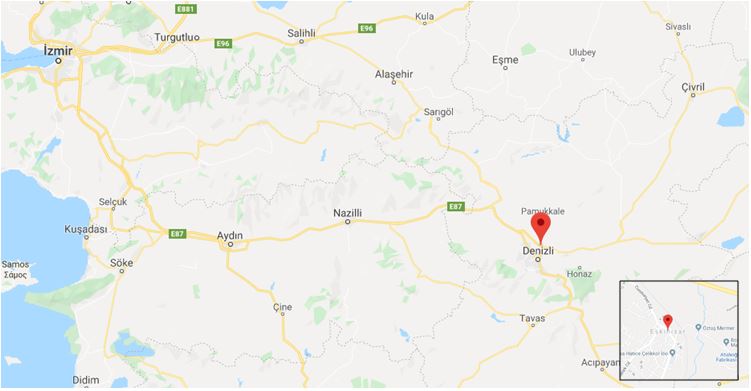
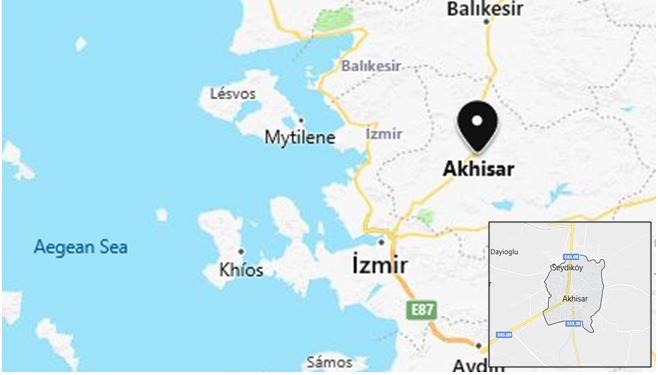
Thyatira/Akhisar

Thyatira

A city on the Lycus, founded by Seleucus Nicator, lay to the left of the road from Pergamos to Sardis, 27 miles from the latter city, and on the very confines of Mysia and Ionia, so as to be sometimes reckoned, within the one and, sometimes, within the other. Dyeing apparently formed an important part of the industrial activity of Thyatira, as it did of that of Colossae and Laodicea. It is first mentioned in connection with Lydia, “a seller of purple.” Act_16:14. One of the Seven Churches of Asia was established here. Rev_2:18-29.
The principal deity of the city was Apollo; but there was another superstition, of an extremely curious nature, which seems to have been brought thither, by some of the corrupted Jews of the dispersed tribes. A fane stood outside the walls, dedicated to Sambatha — the name of the sibyl who is sometimes called Chaldean, sometimes Jewish, sometimes Persian — in the midst of an enclosure designated “the Chaldaeans’ court.”
This seems to lend an illustration to the obscure passage in Rev_2:20-21, which some interpret of the wife of the bishop. Now, there is evidence to show that in Thyatira, there was a great amalgamation of races. If the sibyl Sambatha was in reality a Jewess, lending her aid to the amalgamation of different religions, and not discountenanced by the authorities of the Judeo-Christian Church at Thyatira, both the censure and its qualification become easy of explanation. The present name of the city is Akhisar.

Teaching of Balaam

The Teaching of Balaam

As the Israelites were moving across and procuring the land that God had told them was going to be their home King Balak and other kings were afraid and called on Balaam to curse the Israelites. Numbers 22:2-5  And Balak the son of Zippor saw all that Israel had done to the Amorites. And Moab was in great dread of the people, because they were many. Moab was overcome with fear of the people of Israel. And Moab said to the elders of Midian, “This horde will now lick up all that is around us, as the ox licks up the grass of the field.” So Balak the son of Zippor, who was king of Moab at that time, sent messengers to Balaam the son of Beor at Pethor. We see in Joshua 13:22 Balaam also, the son of Beor, the one who practiced divination, Balaam has made a reputation for himself and is why they would call on him. Further in Numbers 22:7-11 we are told that; the elders of Moab and the elders of Midian departed with the fees for divination in their hand. And they came to Balaam and gave him Balak’s message. And he said to them, “Lodge here tonight, and I will bring back word to you, as the Lord speaks to me.” So the princes of Moab stayed with Balaam. And God came to Balaam and said, “Who are these men with you?” And Balaam said to God, “Balak the son of Zippor, king of Moab, has sent to me, saying, Behold, a people has come out of Egypt, and it covers the face of the earth. Now come, curse them for me. Perhaps I shall be able to fight against them and drive them out.” As you can see they did not get the answer that they wanted so the kings tried over and over again offering more and more money. In fact because of it God one upped those that were trying to curse the Israelites; Deu 23:4-5 because they did not meet you with bread and with water on the way, when you came out of Egypt, and because they hired against you Balaam the son of Beor from Pethor of Mesopotamia, to curse you. But the LORD your God would not listen to Balaam; instead the LORD your God turned the curse into a blessing for you, because the LORD your God loved you. But before the Israelites left this area some conformed to the culture of the area; Num 25:1-3  While Israel lived in Shittim, the people began to whore with the daughters of Moab.  These invited the people to the sacrifices of their gods, and the people ate and bowed down to their gods.  So Israel yoked himself to Baal of Peor. 2 Peter 2:13-15 They count it pleasure to revel in the daytime. They are blots and blemishes, reveling in their deceptions, while they feast with you. They have eyes full of adultery, insatiable for sin. They entice unsteady souls. They have hearts trained in greed. Accursed children! Forsaking the right way, they have gone astray. They have followed the way of Balaam, the son of Beor, who loved gain from wrongdoing. This angered God; Numbers 25:3-5 And the anger of the Lord was kindled against Israel. And the Lord said to Moses, “Take all the chiefs of the people and hang them in the sun before the Lord, that the fierce anger of the Lord may turn away from Israel.” And Moses said to the judges of Israel, “Each of you kill those of his men who have yoked themselves to Baal of Peor.” Numbers 31:16 16 Behold, these, on Balaam’s advice, caused the people of Israel to act treacherously against the Lord in the incident of Peor, and so the plague came among the congregation of the Lord. Joshua 13:22 Balaam also, the son of Beor, the one who practiced divination, was killed with the sword by the people of Israel among the rest of their slain. Back in the past God did not mess around that is why we are warned; Jude 1:11 Woe to them! For they walked in the way of Cain and abandoned themselves for the sake of gain to Balaam’s error and perished in Korah’s rebellion.

Getting to Know Him

Do you want eternal life? Do you want to enter heaven through the only guide that can help you navigate your way there? To enter His home, get to know Him better, and make Him your Lord and Savior CLICK HERE…..

Citation:

Open bible info
Editor: Stephen Smith. Publication date: Apr 10, 2020. Publisher: OpenBible.info.

ESV

The Holy Bible, English Standard Version. ESV® Text Edition: 2016. Copyright © 2001 by Crossway Bibles, a publishing ministry of Good News Publishers.

Bible Gateway

“BibleGateway.” BibleGateway.com: A Searchable Online Bible in over 150 Versions and 50 Languages., http://www.biblegateway.com/‎.

Baal

BAAL

An idol among the ancient Chaldeans and Syrians, representing the sun. The word signifies also lord, or commander; and the character of the idol was varied by different nations, at different times. Thus Baal Berith is supposed to signify the Lord of the Covenant; Baal Peor, or rather Baal Phegor, the Lord of the dead. Ps. cvi, Baal Zebub, the god of flies.

As the Sun-god, Baal was worshipped under two aspects, beneficent and destructive. On the one hand he gave light and warmth to his worshippers; on the other hand the fierce heats of summer destroyed the vegetation he had himself brought into being. Hence, human victims were sacrificed to him in order to appease his anger in time of plague or other trouble, the victim being usually the first-born of the sacrificer and being burnt alive.


Webster’s Dictionary of American English (1828)

International Bible Encyclopedia

Divination

Divination

Divination is “foretelling future events, or discovering things secret by the aid of superior beings, or other than human means”. It is used, in Scripture, of false systems of ascertaining the divine will. It has been universal in all ages, and all nations alike, both civilized and savage.

Numerous forms of divination are mentioned, such as
divination by rods, Hos_4:12,
divination by arrows, Eze_21:21,
divination by cups, Gen_44:5,
consultation of teraphim (images), 1Sa_15:23; Eze_21:21; Zec_10:2,
divination by the liver, Eze_21:21,
divination by dreams, Deu_13:2-3; Jdg_7:13; Jer_23:32, and
consultation of oracles. Isa_41:21-24; Isa_44:7.

Moses forbade every species of divination, because, a prying into the future, clouds the mind with superstition, and because, it would have been an incentive to idolatry. But God supplied his people with substitutes for divination which would have rendered it superfluous, and left them in no doubt as to his will in circumstances of danger, had they continued faithful. It was only when they were unfaithful that the revelation was withdrawn.

Smiths Bible Dictionary

Korah/Because Good was not Good Enough

In Numbers 16 we read about Korah and how he deemed that what Moses was doing was not right, saying Gods plan was wrong. He claimed that Moses was leading them only for personal gain. Numbers 16:3 “You have gone too far! For all in the congregation are holy, every one of them, and the Lord is among them. Why then do you exalt yourselves above the assembly of the Lord?” He was able to stir up opposition between 250 others and started a rebellion. Of the 250 there were those who wanted to regain a certain amount of social status. Korah was part of the Levites; they were able to be close to God all the time but that was still not enough. Numbers 16:7 You have gone too far, sons of Levi!” And Moses said to Korah, “Hear now, you sons of Levi: is it too small a thing for you that the God of Israel has separated you from the congregation of Israel, to bring you near to himself, to do service in the tabernacle of the Lord and to stand before the congregation to minister to them, 10 and that he has brought you near him, and all your brothers the sons of Levi with you? And would you seek the priesthood also? 11 Therefore it is against the Lord that you and all your company have gathered together. Some were Reubenites that had been shamed by what their father had done Chronicles 5:1 The sons of Reuben the firstborn of Israel (for he was the firstborn, but because he defiled his father’s couch, his birthright was given to the sons of Joseph the son of Israel, so that he could not be enrolled as the oldest son. And in Numbers16: 12 And Moses sent to call Dathan and Abiram the sons of Eliab, and they said, “We will not come up. 13 Is it a small thing that you have brought us up out of a land flowing with milk and honey, to kill us in the wilderness, that you must also make yourself a prince over us? 14 Moreover, you have not brought us into a land flowing with milk and honey, nor given us inheritance of fields and vineyards. Will you put out the eyes of these men? We will not come up.”

This angered God and Moses fell to his face and prayed 22  “O God, the God of the spirits of all flesh, shall one man sin, and will you be angry with all the congregation?” Because of this plea God told them to 24 “tell the congregation, Get away from the dwelling of Korah, Dathan, and Abiram.” So the Israelites did and the three families came out prepared to hear receive Gods judgement, 28 And Moses said, “Hereby you shall know that the Lord has sent me to do all these works, and that it has not been of my own accord. 29 If these men die as all men die, or if they are visited by the fate of all mankind, then the Lord has not sent me. 30 But if the Lord creates something new, and the ground opens its mouth and swallows them up with all that belongs to them, and they go down alive into Sheol (hell), then you shall know that these men have despised the Lord.”

31 And as soon as he had finished speaking all these words, the ground under them split apart. 32 And the earth opened its mouth and swallowed them up, with their households and all the people who belonged to Korah and all their goods. 33 So they and all that belonged to them went down alive into Sheol, and the earth closed over them, and they perished from the midst of the assembly. 34 And all Israel who were around them fled at their cry, for they said, “Lest the earth swallow us up!” 35 And fire came out from the Lord and consumed the 250 men offering the incense. Could you imagine seeing this happen right in front of your face? Why would you ever want to question the plans that God has laid out for you? But would you believe that even after that there were 14700 people who still questioned the path that God had for them to travel. 41 But on the next day all the congregation of the people of Israel grumbled against Moses and against Aaron, saying, “You have killed the people of the Lord.” This angered God and again Moses and Aaron stood up for them and interceded for them. 45.” And they fell on their faces. 46 And Moses said to Aaron, “Take your censer, and put fire on it from off the altar and lay incense on it and carry it quickly to the congregation and make atonement for them, for wrath has gone out from the Lord; the plague has begun.” 47 So Aaron took it as Moses said and ran into the midst of the assembly. And behold, the plague had already begun among the people. And he put on the incense and made atonement for the people. 48 And he stood between the dead and the living, and the plague was stopped. 49 Now those who died in the plague were 14,700, besides those who died in the affair of Korah. 50 And Aaron returned to Moses at the entrance of the tent of meeting, when the plague was stopped.

Consumed

Dear Heavenly Father, keep me on solid ground firmly set on Your unmovable foundation. Lord I pray that I am always humble, show me when I am not. Always thankful for all that You have done for me, always willing to step up were You need me. I always want to hold You up in the highest of places in my life. Consume me Lord with everything that You are. In Jesus Name Amen

See to it that you do not refuse [to listen to] Him who is speaking [to you now]. For if those [sons of Israel] did not escape when they refused [to listen to] him who warned them on earth [revealing God’s will], how much less will we escape if we turn our backs on Him who warns from heaven? His voice shook the earth [at Mount Sinai] then, but now He has given a promise, saying, “Yet once more I will shake not only the earth, but also the [starry] heaven.” Now this [expression], “Yet once more,” indicates the removal and final transformation of all those things which can be shaken—that is, of that which has been created—so that those things which cannot be shaken may remain. Therefore, since we receive a kingdom which cannot be shaken, let us show gratitude, and offer to God pleasing service and acceptable worship with reverence and awe; for our God is [indeed] a consuming fire. Hebrews 12:25-29 (AMP)

Don’t Knock the White Hair

When I read the bible I like to break it down into verses phrases, and words. While I was reading the first chapter of Revelation around verse 14 I noticed John described what he saw. As he began he explained that he saw one like the son of man with hair as white as snow. So I wanted to look up any references to white hair in the bible and this is what I found:

Gray hair is a crown of glory; it is gained in a righteous life .Proverbs 16:31 ESV

John the Apostle, not the Baptist

The life of John the son of Zebedee may be summarized in the following sequence. He was a convert of John the Baptist and spent some time with the proclaimer of the new covenant in the Jordan Valley. It was here that he met Jesus and transferred his allegiance from John to Jesus (John 1:19-42). Some time after this, when John and his brother James had resumed fishing, they again encountered Jesus by the Sea of Galilee and at once decided to….>>>>> MORE

Resources » Encyclopedia of The Bible

Remember

Remember:

1.
a. To recall to the mind with effort; think of again
b. To have (something) arise in one’s memory; become aware of (something) suddenly or spontaneously
2. To retain in the memory
3. To keep (someone) in mind as worthy of consideration or recognition.
4. To reward with a gift or tip
5. Engineering To return to (an original shape or form) after being deformed or altered.

Remember:

1. To have in the mind an idea which had been in the mind before, and which recurs to the mind without effort.
We are said to remember any thing, when the idea of it arises in the mind with the consciousness that we have had this idea before.
2. When we use effort to recall an idea, we are said to recollect it. This distinction is not always observed. Hence remember is often used as synonymous with recollect, that is, to call to mind. We say, we cannot remember a fact, when we mean, we cannot recollect it.
Remember the days of old. Deu 32.
3. To bear or keep in mind; to attend to.
Remember what I warn thee; shun to taste.
4. To preserve the memory of; to preserve from being forgotten.
Let them have their wages duly paid, and something over to remember me.
5. To mention. [Not in use.]
6. To put in mind; to remind; as, to remember one of his duty. [Not in use.]
7. To think of and consider; to meditate. Psa 63.
8. To bear in mind with esteem; or to reward. Eccl 9.
9. To bear in mind with praise or admiration; to celebrate. 1 Chr 16.
10. To bear in mind with favor, care, and regard for the safety or deliverance of any one. Psa 74. Gen 8. Gen 19.
11. To bear in mind with intent to reward or punish.
3 John 10. Jer 31.
12. To bear in mind with confidence; to trust in. Psa 20.
13. To bear in mind with the purpose of assisting or relieving. Gal 2.
14. To bear in mind with reverence; to obey.
Remember thy Creator in the days of thy youth. Eccl 12.
15. To bear in mind with regard; to keep as sacred; to observe.
Remember the sabbath day, to keep it holy. Exo 20.


Who were the Nicolaitans

Dear Heavenly Father, as I get to know You more Lord, I am amazed the love that You have for me. Please soften my heart and please allow the Holy Spirit to guide me and help me understand everything that You have in these words. Show me how to apply this message in my life. In Jesus Name Amen

Nicolaitans:

nik-ṓ-lā´i-tanz Νικολαΐταί, Nikolaitaı́

A sect or party of evil influence in early Christianity, especially in the 7 churches of Asia. Their doctrine was similar to that of Balaam, “who taught Balak to cast a stumbling block before the children of Israel, to eat things sacrificed to idols, and to commit fornication” (Rev_2:14-15). Their practices were strongly condemned by John, who praised the church in Ephesus for “hating their works” (Rev_2:6), and blamed the church in Pergamum for accepting in some measure their teaching (Rev_2:15). Except that reference is probably made to their influence in the church at Thyatira also, where their leader was “the woman Jezebel, who calleth herself a prophetess” (Rev_2:20; compare Rev_2:14), no further direct information regarding them is given in Scripture.

Reference to them is frequent in post-apostolic literature. According to Irenaeus (Adv. Haer., i. 26, 3; iii. 10, 7), followed by Hippolytus (Philos., vii. 36), they were founded by Nicolaus, the proselyte of Antioch, who was one of the seven chosen to serve at the tables (Act_6:5). Irenaeus, as also Clement of Alexandria (Strom., ii. 20), Tertullian and others, unite in condemning their practices in terms similar to those of John; and reference is also made to their Gnostic tendencies. In explanation of the apparent incongruity of such an immoral sect being founded by one of “good report, full of the Spirit and of wisdom” (compare Act_6:3), Simcox argues that their lapse may have been due to reaction from original principles of a too rigid asceticism. A theory, started in comparatively modern times, and based in part on the similarity of meaning of the Greek “Nikolaus,” and the Hebrew “Balaam,” puts forward the view that the two sects referred to under these names were in reality identical. Yet if this were so, it would not have been necessary for John to designate them separately.

The problem underlying the Nicolaitan controversy, though so little direct mention is made of it in Scripture, was in reality most important, and concerned the whole relation of Christianity to paganism and its usages. The Nicolaitans disobeyed the command issued to the Gentile churches, by the apostolic council held at Jerusalem in 49-50 AD, that they should refrain from the eating of “things sacrificed to idols” (Act_15:29). Such a restriction, though seemingly hard, in that it prevented the Christian communities from joining in public festivals, and so brought upon them suspicion and dislike, was yet necessary to prevent a return to a pagan laxity of morals. To this danger the Nicolaitans were themselves a glaring witness, and therefore John was justified in condemning them. In writing to the Corinthians, Paul gives warning against the same evil practices, basing his arguments on consideration for the weaker brethren (compare 1Co_8:1-13).

The Jerusalem council (Act_15:20; Act_15:29), while releasing Gentile converts from legalism, required their abstinence from idol meats and associated fornication. The Nicolaitans abused Paul’s doctrine of the grace of God into lasciviousness; such seducers are described as followers of Balsam, also in 2Pe_2:12-19; Jude_1 (“the son of Bosor” for Beor, to characterize him as “son of carnality”: bosor “flesh”). They persuaded many to escape obloquy by yielding as to “eating idol meats,” which was then a test of faithfulness (compare 1 Corinthians 8 and 1Co_10:25-33); they even joined in the “fornication” of the idol feasts, as though permitted by Christ’s “law of liberty.” The “lovefeasts” (Jud_1:12) thus became pagan orgies. The Nicolaitans combined evil “deeds” which Jesus “hates” with evil “doctrine.”

Angels of the Seven Churches

There are separate opinions of who the Angels of the Seven Churches were I will provide the differing explanations A&B.

A Angels of the Seven Churches

It is evident from the contexts of the various Biblical passages in which the word “angel” appears, that the word does not always represent the same idea. In such passages as Dan_12:1 and Act_12:15 it would seem that the angel was generally regarded as a superhuman being whose duty it was to guard a nation or an individual. However, in Mal_2:7 and Mal_3:1 (Hebrew) the word is clearly used to represent men. In the New Testament also, there are passages, such as Jas_2:25 (Greek), in which the word seems to be applied to men. The seven angels of the seven churches (Rev_1:20) received seven letters, figurative letters, and therefore it would seem that the seven angels are also figurative and may refer to the seven bishops who presided over the seven churches of Asia. Or the angels may be regarded as the personifications of the churches.

B ANGELS OF THE SEVEN CHURCHES

1. According to one set of opinions, these angels were men, and the majority of writers have held them to be (1) the presiding presbyters or bishops of their respective churches. But while this view is attractive and popular, the reasons against it are strong. Human officials could hardly be made responsible for their churches as these angels are. A bishop might be called an angel, i.e. a messenger, of God or of Christ (cf. Hag_1:13, Mal_2:7, 2Co_5:20), but would he be called ‘the angel of the church’? Above all, it is certain that at the early date to which the Apocalypse is now generally assigned a settled episcopate was unknown. (2) Others have supposed that the angels were congregational representatives, church messengers or deputies (which would be in harmony with the proper meaning of the word ‘angel’), or even the person who acted as ‘Reader’ to the assembled church (notice ‘he that readeth’ in Rev_1:3). But if the responsibility put upon the angels is too great for bishops, it is much too great for any lesser functionaries. Besides, the glory and dignity assigned to them as the stars of the churches (Rev_1:20) is inconsistent with a position like that of a mere Reader or deputy.
2. A good many have held that ‘angels’ is to be understood in its ordinary Scriptural application, not to men, but to celestial beings. In support of this are—(1) the fact that throughout the rest of the book the Gr. word, which is of very frequent occurrence, is invariably used in this sense; (2) our Lord’s utterance in Mat_18:10, which suggests a doctrine of angelic guardianship; (3) the fact that in Daniel, to which the Apocalypse is so closely related, the guardianship of angels is extended to nations (Dan_12:1). The objections, however, are serious. No definite Scriptural teaching can be adduced in favor of the idea that churches have their guardian-angels. Messages intended for churches would hardly be addressed to celestial beings. Moreover, it is scarcely conceivable that such beings would be identified with particular churches in all their infidelities and shortcomings and transgressions, as these angels are (see, e.g., Dan_3:1; Dan_3:15 ).
3. The most probable view, accordingly, is that the angels are personifications of their churches—not actual persons either on earth or in heaven, but ideal representatives. It is the church, of course, that receives the letter, the ‘Thou’ of address having manifestly a collective force, and it is to the church itself that the letter is sent (cf. Rev_1:11, where there is no mention of the angels). The idea of angels was suggested, no doubt, by the later Jewish beliefs on the subject, but it is used in a figurative manner which suits the whole figurative treatment, where the glorified Jesus walks among the golden candlesticks, and sends to the churches messages that are couched in highly metaphorical language. It might seem to be against this ideal view that the seven churches, as candlesticks, are definitely distinguished from the seven angels, as stars (Rev_1:12; Rev_1:16; Rev_1:20). But it is quite in keeping with the inevitable distinction between an actual and an ideal church that they should be thus contrasted as a lamp and a star.


A. International Standard Bible Encyclopedia
B. Hastings Dictionary of the Bible

Love: Definition


Love:

1. An affection of the mind excited by beauty and worth of any kind, or by the qualities of an object which communicate pleasure, sensual or intellectual. It is opposed to hatred. Love between the sexes, is a compound affection, consisting of esteem, benevolence, and animal desire. Love is excited by pleasing qualities of any kind, as by kindness, benevolence, charity, and by the qualities which render social intercourse agreeable. In the latter case, love is ardent friendship, or a strong attachment springing from good will and esteem, and the pleasure derived from the company, civilities and kindness of others.
Between certain natural relatives, love seems to be in some cases instinctive. Such is the love of a mother for her child, which manifests itself toward an infant, before any particular qualities in the child are unfolded. This affection is apparently as strong in irrational animals as in human beings.
We speak of the love of amusements, the love of books, the love of money, and the love of whatever contributes to our pleasure or supposed profit.
The love of God is the first duty of man, and this springs from just views of his attributes or excellencies of character, which afford the highest delight to the sanctified heart. Esteem and reverence constitute ingredients in this affection, and a fear of offending him is its inseparable effect.
2. Courtship; chiefly in the phrase, to make love, that is, to court; to woo; to solicit union in marriage.
3. Patriotism; the attachment one has to his native land; as the love of country.
4. Benevolence; good will.

Abandoned

Abandoned:

1.Wholly forsaken or deserted.
2. Given up, as to a vice; hence, extremely wicked, or sinning without restraint; irreclaimably wicked.

Weary

Weary:

1. Having the strength much exhausted by toil or violent exertion; tired; fatigued. [It should be observed however that this word expresses less than tired, particularly when applied to a beast; as a tired horse. It is followed by of, before the cause of fatigue; as, to be weary of marching; to be weary of reaping; to be weary of study.]
2. Having the patience exhausted, or the mind yielding to discouragement. He was weary of asking for redress.
3. Causing weariness; tiresome; as a weary way; a weary life.

False


False:

to deceive.
1. Not true; not conformable to fact; expressing what is contrary to that which exists, is done, said or thought. A false report communicates what is not done or said. A false accusation imputes to a person what he has not done or said. A false witness testifies what is not true. A false opinion is not according to truth or fact. The word is applicable to any subject, physical or moral.
2. Not well founded; as a false claim.
3. Not true; not according to the lawful standard; as a false weight or measure.
4. Substituted for another; succedaneous; supposititious; as a false bottom.
5. Counterfeit; forged; not genuine; as false coin; a false bill or note.
6. Not solid or sound; deceiving expectations; as a false foundation
False and slippery ground.
7. Not agreeable to rule or propriety; as false construction in language.
8. Not honest or just; not fair; as false play.
9. Not faithful or loyal; treacherous; perfidious; deceitful. The king’s subjects may prove false to him. So we say, a false heart.
10. Unfaithful; inconstant; as a false friend; a false lover; false to promises and vows.
The husband and wife proved false to each other.
11. Deceitful; treacherous; betraying secrets.
12. Counterfeit; not genuine or real; as a false diamond.
13. Hypocritical; feigned; made or assumed for the purpose of deception; as false tears; false modesty. The man appears in false colors. The advocate gave the subject a false coloring.

Apostles


Apostles:

A person deputed to execute some important business; but appropriately, a disciple of Christ commissioned to preach the gospel. Twelve persons were selected by Christ for this purpose; and Judas, one of the number, proving an apostate, his place was supplied by Matthias. Acts 1.
The title of apostle is applied to Christ himself, Heb 3. In the primitive ages of the church, other ministers were called apostles, Rom 16; as were persons sent to carry alms from one church to another, Phil 2. This title was also given to persons who first planted the Christian faith. Thus Dionysius of Corinth is called the apostle of France; and the Jesuit Missionaries are called apostles.
Among the Jews, the title was given to officers who were sent into distant provinces, as visitors or commissioners, to see the laws observed.
Apostle, in the Greek liturgy, is a book contained the epistles of St. Paul, printed in the order in which they are to be read in churches, through the year.

Evil


Evil:

1. Having bad qualities of a natural kind; mischievous; having qualities which tend to injury, or to produce mischief.
2. Having bad qualities of a moral kind; wicked; corrupt; perverse; wrong; as evil thoughts; evil deeds; evil speaking; an evil generation.
3. Unfortunate; unhappy; producing sorrow, distress, injury or calamity; as evil tidings; evil arrows; evil days.

Evil:

Evil is natural or moral. Natural evil is any thing which produces pain, distress, loss or calamity, or which in any way disturbs the peace, impairs the happiness, or destroys the perfection of natural beings.
Moral evil is any deviation of a moral agent from the rules of conduct prescribed to him by God, or by legitimate human authority; or it is any violation of the plain principles of justice and rectitude.
There are also evils called civil, which affect injuriously the peace or prosperity of a city or state; and political evils, which injure a nation, in its public capacity.
All wickedness, all crimes, all violations of law and right are moral evils. Diseases are natural evils, but they often proceed from moral evils.

Bear


Bear:

To tolerate, to hold up; support: to hold or remain firm under (a load)

Endurance


Endurance:

Continuance; a state of lasting or duration; lastingness. A bearing or suffering; continuing under pain or distress without resistance, or without sinking or yielding to the pressure; sufferance; patience.

Toil

Toil


Toil:

To be engaged in physical or mental activity in order to achieve a purpose or result, especially in one’s job; do work.

Works


Works:

Be engaged in physical or mental activity in order to achieve a purpose or result, especially in one’s job; do work.

Ephesus

Ephesus

The capital of proconsular Asia, which was the western part of Asia Minor. It was colonized principally from Athens. In the time of the Romans it bore the title of “the first and greatest metropolis of Asia.” It was distinguished for the Temple of Diana, who there had her chief shrine; and for its theatre, which was the largest in the world, capable of containing 50,000 spectators. It was, like all ancient theatres, open to the sky.

“To the angel of the church in Ephesus write: ‘The words of him who holds the seven stars in his right hand, who walks among the seven golden lampstands.  I know your works, your toil and your patient endurance, and how you cannot bear with those who are evil, but have tested those who call themselves apostles and are not, and found them to be false. I know you are enduring patiently and bearing up for my name’s sake, and you have not grown weary. But I have this against you that you have abandoned the love you had at first. Remember therefore from where you have fallen; repent, and do the works you did at first. If not, I will come to you and remove your lampstand from its place, unless you repent. Yet this you have: you hate the works of the Nicolaitans, which I also hate. He who has an ear, let him hear what the Spirit says to the churches. To the one who conquers I will grant to eat of the tree of life, which is in the paradise of God.” Revelation 2:1-7 ESV

The Place to be

Ephesus was 3 miles from the western coast of Asia Minor, and opposite the island of Samos. With an artificial harbor accessible to the largest ships, and rivaling the harbor at Miletus, standing at the entrance of the valley which reaches far into the interior of Asia Minor, and connected by highways with the chief cities of the province, Ephesus was the most easily accessible city in Asia, both by land and sea. Its location, therefore, favored its religious, political and commercial development, and presented a most advantageous field for the missionary labors of Paul. The city stood upon the sloping sides and at the base of two hills, Prion and Coressus, commanding a beautiful view; its climate was exceptionally fine, and the soil of the valley was unusually fertile.

Permissible

Not only was the temple of Diana a place of worship, and a treasure-house, but it was also a museum in which the best statuary and most beautiful paintings were preserved. Among the paintings was one by the famous Apelles, a native of Ephesus, representing Alexander the Great hurling a thunderbolt. It was also a sanctuary for the criminal, a kind of city of refuge, for none might be arrested for any crime whatever when within a bowshot of its walls. There sprang up, therefore, about the temple a village in which the thieves and murderers and other criminals made their homes. Not only did the temple bring vast numbers of pilgrims to the city, as does the Kaaba at Mecca at the present time, but it employed hosts of people apart from the priests and priestesses; among them were the large number of artisans who manufactured images of the goddess Diana, or shrines to sell to the visiting strangers.

There and Gone

In time the pilgrims, with decreasing faith in Diana, came in fewer numbers; the sales of the shrines of the goddess fell off; Diana of the Ephesians was no longer great; a Christian church was founded there and flourished, and one of its first leaders was the apostle John. Finally in 262 ad, when the temple of Diana was again burned, its influence had so far departed that it was never again rebuilt. Diana was dead. Ephesus became a Christian city, and in 341 ad a council of the Christian church was held there. The city itself soon lost its importance and decreased in population. The sculptured stones of its great buildings, which were no longer in use and were falling to ruins, were carried away to Italy, and especially to Constantinople for the great church of Saint Sophia. In 1308 the Turks took possession of the little that remained of the city, and deported or murdered its inhabitants.

Getting to Know Him

Do you want eternal life? Do you want to enter heaven through the only guide that can help you navigate your way there? To enter His home, get to know Him better, and make Him your Lord and Savior CLICK HERE…..

Citations:

Esword

“Sword: Free Bible Study for the PC.” Eastons Bible Dictionary, International Bible Encyclopedia, e-sword.net/.

Bible Gateway

 “BibleGateway.” BibleGateway.com: A Searchable Online Bible in over 150 Versions and 50 Languages., http://www.biblegateway.com/‎.

ESV

The Holy Bible, English Standard Version. ESV® Text Edition: 2016. Copyright © 2001 by Crossway Bibles, a publishing ministry of Good News Publishers.

Repent


Repent

Definition: to feel such sorrow for sin or fault as to be disposed to change one’s life for the better; be penitent.

Synonyms: apologize, atone, deplore, lament, reform, regret, relent, sorrow, be ashamed, be sorry, feel remorse


What does the bible say:

2 Chronicles 7:14
If my people who are called by my name humble themselves, and pray and seek my face and turn from their wicked ways, then I will hear from heaven and will forgive their sin and heal their land.

1 John 1:9
If we confess our sins, he is faithful and just to forgive us our sins and to cleanse us from all unrighteousness.

Temptation


Last…..

Then Jesus was led up by the Spirit into the wilderness to be tempted by the devil. And when He had fasted forty days and forty nights, afterward He was hungry. Now when the tempter came to Him, he said, “If You are the Son of God, command that these stones become bread.”  But He answered and said, “It is written, man shall not live by bread alone, but by every word that proceeds from the mouth of God.” Then the devil took Him up into the holy city, set Him on the pinnacle of the temple, and said to Him, “If You are the Son of God, throw Yourself down. For it is written: He shall give His angels charge over you and In their hands they shall bear you up, Lest you dash your foot against a stone.” Jesus said to him, “It is written again, you shall not tempt the Lord your God.” Again the devil took Him up on an exceedingly high mountain and showed Him all the kingdoms of the world and their glory. And he said to Him, “All these things I will give You if You will fall down and worship me.” Then Jesus said to him, “Away with you, Satan! For it is written, “you shall worship the Lord your God, and Him only you shall serve.” Then the devil left Him, and behold, angels came and ministered to Him. Mark 4:1-11

Now as we look further the devil shows how deceitful and tricky he can be. The devil now uses the words of Jesus Himself “for it is written”, this is a perfect example of how the devil uses any means necessary to deceive anyone he is trying to overcome. And no wonder, for even Satan disguises himself as an angel of light. 2 Corinthians 11:14 The devil will even try and use the bible to confirm his detours, make sure you are familiar with the words that God gave us. Be sober-minded; be watchful. Your adversary the devil prowls around like a roaring lion, seeking someone to devour. 1 Peter 5:8 We are told in the bible the closer we get to Christ’s return it is going to get even easier for the devil to deceive people:  For the time will come when they will not endure sound doctrine, but according to their own desires, because they have itching ears, they will heap up for themselves teachers;  and they will turn their ears away from the truth, and be turned aside to fables. 2 Timothy 4:3-4 With this said you can see how the devil will be able to trick people, he will tell them what they want to hear, they will look to their own knowledge not trusting what God has told us all in the bible. Trust Him, have the faith of the mustard seed allowing God to be your guide.

MORE….