Dear Heavenly Father; help me to see everything the way You see it Lord. I begin to feel sorry for myself convincing my mind that I am the only one that has gone through the things that I am going through, thinking that You have abandoned me Lord that You are disregarding me. Lord I am sorry all of these are issues in my mind that are making so I do not see all the great irrefutable things You have done for me. Lord eradicate these reservations that I allow to creep into my mind, surround me with all of Your fortifications not allowing these uncertainties to become part of my thoughts or part of my existence. In Jesus Name Amen
Have you ever had those moments, even weeks, where all you want to do is scream at God and say why; why are you doing this to me. I think if we are honest with ourselves we can all say yes, these times make us feel like God hates us. We need to remember God does not hate us He sent His son to save us from the ultimate punishment hell. When we feel like there is to much for us to bear start counting all of the good things that He has done for you and praise Him. When we praise God, setting our thought and mind on Him, we push out the thoughts of negativity and focus on God instead of focusing on ourselves it will change your mind set. We are not the only ones that have dealt with attacks Paul and David did also and this is what they told us: Do not be overcome by evil, but overcome evil with good. Romans 12:21 ESV Not that I have already obtained this or am already perfect, but I press on to make it my own, because Christ Jesus has made me his own. Brothers, I do not consider that I have made it my own. But one thing I do: forgetting what lies behind and straining forward to what lies ahead, I press on toward the goal for the prize of the upward call of God in Christ Jesus. Philippians 3:12-14 ESV Many are the afflictions of the righteous, but the Lord delivers him out of them all. He keeps all his bones; not one of them is broken. Psalm 34:19-20 ESV
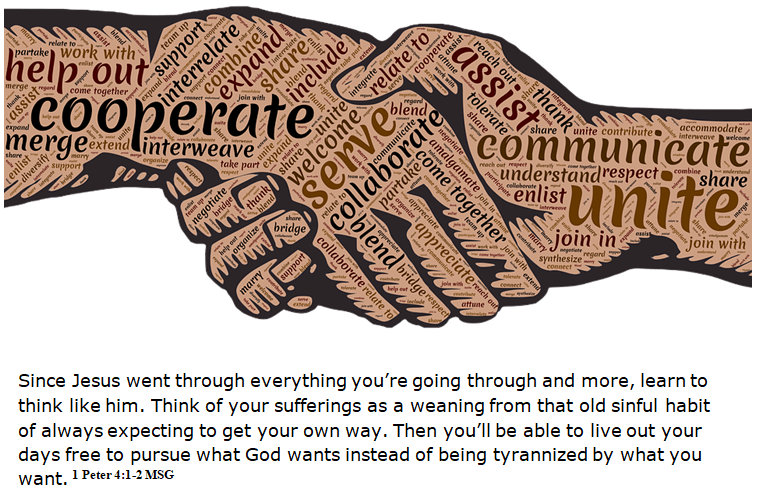
Since Jesus went through everything you’re going through and more, learn to think like him. Think of your sufferings as a weaning from that old sinful habit of always expecting to get your own way. Then you’ll be able to live out your days free to pursue what God wants instead of being tyrannized by what you want.1 Peter 4:1-2 MSG
Dear Heavenly Father, as I enter a new year and another decade please guide every foot step that I take. Show me how to be a light to everyone that needs it while helping me to see things the way You do. In Zechariah 2:5 (AMP) You tell Jerusalem that you will protect them: “For I, declares the Lord, will be a wall of fire around her [protecting her from enemies], and I will be the glory in her midst.” Lord put that wall of fire around me, my family, and friends giving us your almighty protection. As this new year and decade begin help me to recognize those who are trying to deceive me (Beloved, do not believe every spirit, but test the spirits to see whether they are from God, for many false prophets have gone out into the world. 1 John 4:1 ESV) When presented with the many options that come my way show me Your ways so that I do not conform to this world (Do not be conformed to this world, but be transformed by the renewal of your mind, that by testing you may discern what is the will of God, what is good and acceptable and perfect. Romans 12:2 ESV) Teach me your way, O Lord, that I may walk in your truth; unite my heart to fear your name. Psalm 86:11 ESV for you are my rock and my fortress; and for your name’s sake you lead me and guide me; Psalm 31:3 ESV Make me to know your ways, O Lord; teach me your paths. Lead me in your truth and teach me, for you are the God of my salvation; for you I wait all the day long. Psalm 25:4-5 ESV Lead me, O Lord, in your righteousness because of my enemies; make your way straight before me. Psalm 5:8 ESV In Jesus Name Amen
“Remember not the former things, nor consider the things of old. Behold, I am doing a new thing; now it springs forth, do you not perceive it? I will make a way in the wilderness and rivers in the desert. Isaiah 43:18-19 ESV
When he had washed their feet and put on his outer garments and resumed his place, he said to them, “Do you understand what I have done to you? You call me Teacher and Lord, and you are right, for so I am. If I then, your Lord and Teacher, have washed your feet, you also ought to wash one another’s feet. For I have given you an example, that you also should do just as I have done to you. John 13:12-15 (ESV)
Throughout the bible we are told to help tend His flock; the broken hearted, widows, children, and hurting people. We have been instructed to serve and not be served, to Love even when you are hated, and to hope even when it seems hopeless.
Dear Heavenly Father, help us to lead the way that You lead, to see the way that You see, to feel the way You feel. Lord surround Your leaders with that impenetrable fiery wall of protection You put around Jerusalem, cover them with Your blood and fill them with the Holy Spirit directing every step they take. In Jesus Name Amen
Dear Heavenly Father, let me always see who You are see things through Your eyes. Help me to personally know You through the word, be my light in the darkness Lord. You were here in the beginning and have the answers to all of the questions that I have. Thank You Lord for your gift, Your sacrifice and Your love! In Jesus Name Amen.
For to us a child is born, to us a son is given, and the government will be on his shoulders. And he will be called Wonderful Counselor, Mighty God, Everlasting Father, Prince of Peace. Of the greatness of his government and peace there will be no end. Isaiah 9:6-7
Dear Heavenly Father, please be our guide through this study of the Seven Churches in Revelation. Show us Your meaning not one skewed with our thoughts and experience, but only Your thoughts. In Jesus Name Amen.
Sitting in a jail cell gives one extra time to think, ponder life and pray. John was in Patmos serving time for unlawfully sharing the message of Jesus Christ in Ephesus. The Jewish elite, because of Roman persecution, had thrown Christians under the bus to Domitian, a Roman Emperor. The elite said because the Christians taught the reality of who Jesus was that He came to earth to save us all, and was raised after three days from the dead. It would cause dire consequences to the Roman Empire. At this time if this message was shared it could be, if permitted, jail time and even death. In a time of meditation and prayer, in the “Spirit”, John heard a loud voice behind him. Picture that you are in a room all by yourself all is silent and all of a sudden “WRITE WHAT YOU SEE”, super loud. Do you think he jumped? Maybe a scream? I know what I would have done, my head would hit the ceiling, it would have been a good thing it was Jesus Christ because I would of probably needed a head wound healed.
Now after taking a moment to regain a little composure, if at all, he turns around to someone standing there surrounded by lampstands. Looking like royalty, white hair, flames in His eyes, and when He spoke it was deafening. He was holding seven stars in His hand, when He would speak out of His would came a double edge sword, and the light coming off of Him was bright enough John could not stand to look at Him for too long. You know someone you would expect to see in a prison cell. John says “I feel at His feet as though I was dead”, immediately a hand of comfort reaches out and says” Fear not, I am the first and the last, and the living one. I died, and behold I am alive forevermore”. He lets John know I am Jesus, I am here, and everything is all right. My children need to hear some things and I need you to write them down and deliver it to them.
In this journey through the vision of the seven churches of Revelation we will see the love that our God has for us. You will see that with fulfilling the prophesy of coming to earth, being crucified, and raised from the dead three days later; did not mean that He then ascended to Heaven put His feet up sat back on His throne and said “I am good now take care of it”. No; He came down once more and said hey, I love you and you did not hear what I said, you need to take care of this our we will not be able to see each other. The message that He left to the Seven Churches still resonates today, in some aspects more now then back when the Revelation was given to John. We will see how some would twist the word for personal gain; others would get to comfortable and think they could do it better then God. Groups that would try to justify their sin through the teaching of Christ, and a few that use deceitfulness to try and destroy what Jesus had done for them. With the warnings and acknowledgments that are given in these seven letters we can see that if we apply them to our lives it will make our walk with Christ even closer then you could have ever imagined.
Vision of the Son of Man
I, John, your brother and partner in the tribulation and the kingdom and the patient endurance that are in Jesus, was on the island called Patmos on account of the word of God and the testimony of Jesus. I was in the Spirit on the Lord’s Day, and I heard behind me a loud voice like a trumpet saying, “Write what you see in a book and send it to the seven churches, to Ephesus and to Smyrna and to Pergamum and to Thyatira and to Sardis and to Philadelphia and to Laodicea.”
Then I turned to see the voice that was speaking to me, and on turning I saw seven golden lampstands, and in the midst of the lampstands one like a son of man, clothed with a long robe and with a golden sash around his chest. The hairs of his head were white, like white wool, like snow. His eyes were like a flame of fire, his feet were like burnished bronze, refined in a furnace, and his voice was like the roar of many waters. In his right hand he held seven stars, from his mouth came a sharp two-edged sword, and his face was like the sun shining in full strength.
When I saw him, I fell at his feet as though dead. But he laid his right hand on me, saying, “Fear not, I am the first and the last, and the living one. I died, and behold I am alive forevermore, and I have the keys of Death and Hades. Write therefore the things that you have seen those that are and those that are to take place after this. As for the mystery of the seven stars that you saw in my right hand, and the seven golden lampstands, the seven stars are the angels of the seven churches, and the seven lampstands are the seven churches. Revelation 1:9-20 (ESV)
A city of Asia Minor situated in the Lycos valley in the province of Phrygia, and the home of one of the Seven Churches of Revelation. Distinguished from several other cities of that name by the appellation Ad Lycum, it was founded by Antiochus II (261-246 BC) of Syria, who named it for his wife Laodike, and who populated it with Syrians and with Jews who were transplanted from Babylonia to the cities of Phrygia and Lydia.
“And to the angel of the church in Laodicea write: The words of the Amen, the faithful and true witness, the beginning of God’s creation. “I know your works: you are neither cold nor hot. Would that you were either cold or hot! So, because you are lukewarm, and neither hot nor cold, I will spit you out of my mouth. For you say, I am rich, I have prospered, and I need nothing, not realizing that you are wretched, pitiable, poor, blind, and naked. I counsel you to buy from me gold refined by fire, so that you may be rich, and white garments so that you may clothe yourself and the shame of your nakedness may not be seen, and salve to anoint your eyes, so that you may see. Those whom I love, I reprove and discipline, so be zealous and repent. Behold, I stand at the door and knock. If anyone hears my voice and opens the door, I will come in to him and eat with him, and he with me. The one who conquers, I will grant him to sit with me on my throne, as I also conquered and sat down with my Father on his throne. He who has an ear, let him hear what the Spirit says to the churches.” Revelation 3:14-22 ESV
Though Laodicea stood on the great highway at the junction of several important routes, it was a place of little consequence until the Roman province of Asia was formed in 190 BC. It then suddenly became a great and wealthy center of industry, famous specially for the fine black wool of its sheep and for the Phrygian powder for the eyes, which was manufactured there (compare Rev_3:18). In the vicinity was the temple of Men Karou and a renowned school of medicine. In the year 60 AD, the city was almost entirely destroyed by an earthquake, but so wealthy were its citizens that they rejected the offered aid of Rome, and quickly rebuilt it at their own expense (compare Rev_3:17). It was a city of great wealth, with extensive banking operations (compare Rev_3:18). Little is known of the early history of Christianity there; Timothy, Mark and Epaphras (Col_1:7) seem to have been the first to introduce it. However, Laodicea was early the chief bishopric of Phrygia, and about 166 AD Sagaris, its bishop, was martyred. In 1071 the city was taken by the Seljuks; in 1119 it was recovered to the Christians by John Comnenus, and in the 13th century it fell finally into the hands of the Turks.
Getting to Know Him
Do you want eternal life? Do you want to enter heaven through the only guide that can help you navigate your way there? To enter His home, get to know Him better, and make Him your Lord and Savior CLICK HERE…..
Citations:
Esword
“Sword: Free Bible Study for the PC.” Matthew Henry’s Concise Commentary , e-sword.net/.
Bible Gateway
“BibleGateway.” BibleGateway.com: A Searchable Online Bible in over 150 Versions and 50 Languages., http://www.biblegateway.com/.
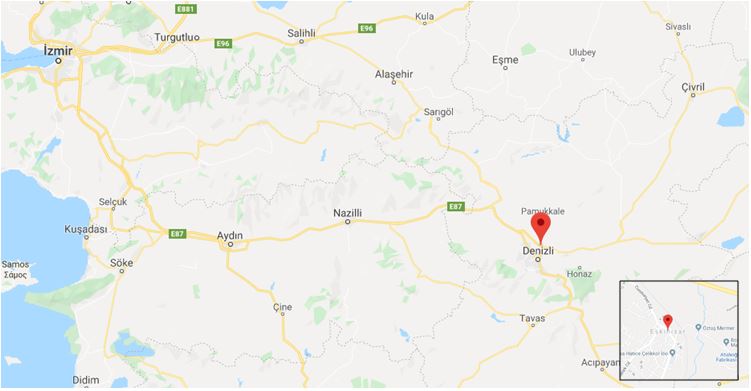
was a city of Lydia, 28 miles from Sardis, in the valley of the Cogamis, a tributary of the Hermus, and conveniently situated for receiving the trade between the great central plateau of Asia Minor and Smyrna. The district known as Katakekaumene (‘Burnt Region’), because of its volcanic character, rises immediately to the N.E. of Philadelphia, and this was a great vine-producing region.
Philadelphia was founded and named by Attalus Philadelphus of Pergamos before B.C. 138. It was liable to serious earthquakes, but remained an important centre of the Roman province of Asia, receiving the name of Neo-Cæsarea from Tiberius, and, later on, the honour of the Neocorate (i.e. the wardenship of the temple for Emperor-worship). There is no record of the beginning of the Church at Philadelphia, but in the Apocalypse it is one of the seven churches to which, as heads of districts, special messages are sent. In its message (Rev 3:7-13 ESV)
“And to the angel of the church in Philadelphia write: The words of the holy one, the true one, who has the key of David, who opens and no one will shut, who shuts and no one opens. I know your works. Behold, I have set before you an open door, which no one is able to shut. I know that you have but little power, and yet you have kept my word and have not denied my name. Behold, I will make those of the synagogue of Satan who say that they are Jews and are not, but lie—behold, I will make them come and bow down before your feet, and they will learn that I have loved you. Because you have kept my word about patient endurance, I will keep you from the hour of trial that is coming on the whole world, to try those who dwell on the earth. I am coming soon. Hold fast what you have, so that no one may seize your crown. The one who conquers, I will make him a pillar in the temple of my God. Never shall he go out of it, and I will write on him the name of my God, and the name of the city of my God, the new Jerusalem, which comes down from my God out of heaven, and my own new name. He who has an ear, let him hear what the Spirit says to the churches.” Revelation 3:7-13 ESV
It is said to have ‘a little strength’ (which perhaps refers to its recent origin), and to have set before it ‘an open door,’ which seems to refer to the opportunities it had of spreading the gospel in the center of Asia Minor. In 3:9 ‘the synagogue of Satan which say they are Jews and are not’ must mean that the Jews of Philadelphia had been lax, and had conceded too much to Gentile ways. But the message contains no reproach against the Christians, although they are bidden to hold fast that which they have, and the promise to him that over cometh is that ‘I will write upon him the name of my God, and the name of the city of my God, the new Jerusalem, … and mine own new name.’ Doubtless there is a reference here, as in the message to Pergamus, to the new name taken at baptism, and apparently sometimes kept secret.
Philadelphia was the seat of a bishop, but was not a metropolis until about A.D. 1300, when the importance of Sardis had become less. In the 14th cent., when the Greek Empire retained nothing on the mainland of Asia except a strip of territory opposite Constantinople, Philadelphia still resisted the Ottoman arms, though far from the sea and almost forgotten by the Emperors. In the words of Gibbon (ch. lxiv): ‘Among the Greek colonies and churches of Asia, Philadelphia is still erect, a column in a scene of ruins: a pleasing example that the paths of honor and safety may sometimes be the same.’ The date of its final capture is uncertain—probably A.D. 1391. Its modern name is Alaşehir.
Getting to Know Him
Do you want eternal life? Do you want to enter heaven through the only guide that can help you navigate your way there? To enter His home, get to know Him better, and make Him your Lord and Savior CLICK HERE…..
Dear Heavenly Father, it seems like lately I cannot catch a break. Lord take away this darkness that surrounds me and cover me in you light. I release gloom that has been on me I give it to You, make my bones strong and guide my every step so I can be Your spring whose waters never fail. In Jesus Name Amen
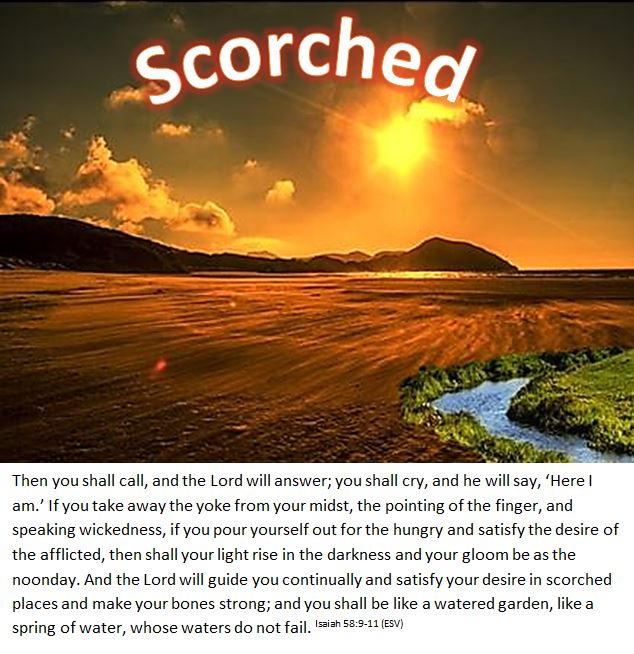
Then you shall call, and the Lord will answer; you shall cry, and he will say, ‘Here I am.’ If you take away the yoke from your midst, the pointing of the finger, and speaking wickedness, if you pour yourself out for the hungry and satisfy the desire of the afflicted, then shall your light rise in the darkness and your gloom be as the noonday. And the Lord will guide you continually and satisfy your desire in scorched places and make your bones strong; and you shall be like a watered garden, like a spring of water, whose waters do not fail. Isaiah 58:9-11 (ESV)
A city of Asia Minor , and capital of Lydia, situated about two miles to the south of the river Hermus, just below the range of Tmolus, on a spur of which its Acropolis was built. It was 60 miles northeast of Smyrna. It was the ancient residence of the kings of Lydia, among them Croesus, proverbial for his immense wealth. Cyrus is said to have taken $600,000,000 worth of treasure form the city when he captured it, B.C. 548.
Sardis was, in very early times, both from the extremely fertile character of the neighboring region, and from its convenient position, a commercial mart of importance. The art of dyeing wool is said to have been invented there. In the year 214 B.C., it was taken and sacked by the army of Antiochus, the Great. Afterward, it passed under the dominion of the kings of Pergamos. Its productive soil must always have continued a source of wealth; but its importance as a central mart appears to have diminished, from the time of the invasion of Asia by Alexander.
The massive temple of Cybele still bears witness, in its fragmentary remains, to the wealth and architectural skill of the people that raised it. On the north side of the Acropolis, overlooking the valley of the Hermus, is a theatre nearly 400 feet in diameter, attached to a stadium of about 1000 feet. There are still considerable remains of the ancient city at Sart. Travelers describe the appearance of the locality as that of complete solitude. The only passage in which it is mentioned in the Bible is Rev_3:1-6.
The ancient city was noted for its fruits and wool, and for its temple of the goddess Cybele, whose worship resembled that of Diana of Ephesus. Its wealth was also partly due to the gold which was found in the sand of the river Pactolus, and it was here that gold and silver coins were first struck. During the Roman period its coins formed a beautiful series, and are found in abundance by the peasants who till the surrounding fields. The ruins of the buildings which stood at the base of the hill have now been nearly buried by the dirt washed down from above. The hill upon which the acropolis stood measures 950 ft. high: the triple walls still surround it. The more imposing of the ruins are on the lower slope of the hill, and among them the temple of Cybele is the most interesting, yet only two of its many stone columns are still standing.
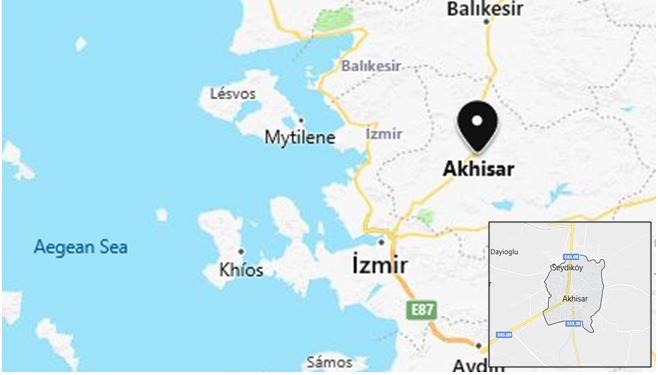
A city on the Lycus, founded by Seleucus Nicator, lay to the left of the road from Pergamos to Sardis, 27 miles from the latter city, and on the very confines of Mysia and Ionia, so as to be sometimes reckoned, within the one and, sometimes, within the other. Dyeing apparently formed an important part of the industrial activity of Thyatira, as it did of that of Colossae and Laodicea. It is first mentioned in connection with Lydia, “a seller of purple.” Act_16:14. One of the Seven Churches of Asia was established here. Rev_2:18-29.
The principal deity of the city was Apollo; but there was another superstition, of an extremely curious nature, which seems to have been brought thither, by some of the corrupted Jews of the dispersed tribes. A fane stood outside the walls, dedicated to Sambatha — the name of the sibyl who is sometimes called Chaldean, sometimes Jewish, sometimes Persian — in the midst of an enclosure designated “the Chaldaeans’ court.”
This seems to lend an illustration to the obscure passage in Rev_2:20-21, which some interpret of the wife of the bishop. Now, there is evidence to show that in Thyatira, there was a great amalgamation of races. If the sibyl Sambatha was in reality a Jewess, lending her aid to the amalgamation of different religions, and not discountenanced by the authorities of the Judeo-Christian Church at Thyatira, both the censure and its qualification become easy of explanation. The present name of the city is Akhisar.
As the Israelites were moving across and procuring the land that God had told them was going to be their home King Balak and other kings were afraid and called on Balaam to curse the Israelites. Numbers 22:2-5 And Balak the son of Zippor saw all that Israel had done to the Amorites.And Moab was in great dread of the people, because they were many. Moab was overcome with fear of the people of Israel.And Moab said to the elders of Midian, “This horde will now lick up all that is around us, as the ox licks up the grass of the field.” So Balak the son of Zippor, who was king of Moab at that time,sent messengers to Balaam the son of Beor at Pethor. We see in Joshua 13:22 Balaam also, the son of Beor, the one who practiced divination, Balaam has made a reputation for himself and is why they would call on him. Further in Numbers 22:7-11 we are told that; the elders of Moab and the elders of Midian departed with the fees for divination in their hand. And they came to Balaam and gave him Balak’s message. And he said to them, “Lodge here tonight, and I will bring back word to you, as the Lord speaks to me.” So the princes of Moab stayed with Balaam. And God came to Balaam and said, “Who are these men with you?” And Balaam said to God, “Balak the son of Zippor, king of Moab, has sent to me, saying, Behold, a people has come out of Egypt, and it covers the face of the earth. Now come, curse them for me. Perhaps I shall be able to fight against them and drive them out.” As you can see they did not get the answer that they wanted so the kings tried over and over again offering more and more money. In fact because of it God one upped those that were trying to curse the Israelites; Deu 23:4-5 because they did not meet you with bread and with water on the way, when you came out of Egypt, and because they hired against you Balaam the son of Beor from Pethor of Mesopotamia, to curse you. But the LORD your God would not listen to Balaam; instead the LORD your God turned the curse into a blessing for you, because the LORD your God loved you. But before the Israelites left this area some conformed to the culture of the area; Num 25:1-3 While Israel lived in Shittim, the people began to whore with the daughters of Moab. These invited the people to the sacrifices of their gods, and the people ate and bowed down to their gods. So Israel yoked himself to Baal of Peor. 2 Peter 2:13-15 They count it pleasure to revel in the daytime. They are blots and blemishes, reveling in their deceptions, while they feast with you. They have eyes full of adultery, insatiable for sin. They entice unsteady souls. They have hearts trained in greed. Accursed children! Forsaking the right way, they have gone astray. They have followed the way of Balaam, the son of Beor, who loved gain from wrongdoing. This angered God;Numbers 25:3-5 And the anger of the Lord was kindled against Israel. And the Lord said to Moses, “Take all the chiefs of the people and hang them in the sun before the Lord, that the fierce anger of the Lord may turn away from Israel.” And Moses said to the judges of Israel, “Each of you kill those of his men who have yoked themselves to Baal of Peor.”Numbers 31:16 16 Behold, these, on Balaam’s advice, caused the people of Israel to act treacherously against the Lord in the incident of Peor, and so the plague came among the congregation of the Lord. Joshua 13:22 Balaam also, the son of Beor, the one who practiced divination, was killed with the sword by the people of Israel among the rest of their slain. Back in the past God did not mess around that is why we are warned; Jude 1:11 Woe to them! For they walked in the way of Cain and abandoned themselves for the sake of gain to Balaam’s error and perished in Korah’s rebellion.
Getting to Know Him
Do you want eternal life? Do you want to enter heaven through the only guide that can help you navigate your way there? To enter His home, get to know Him better, and make Him your Lord and Savior CLICK HERE…..
Citation:
Open bible info Editor: Stephen Smith. Publication date: Apr 10, 2020. Publisher: OpenBible.info.
An idol among the ancient Chaldeans and Syrians, representing the sun. The word signifies also lord, or commander; and the character of the idol was varied by different nations, at different times. Thus Baal Berith is supposed to signify the Lord of the Covenant; Baal Peor, or rather Baal Phegor, the Lord of the dead. Ps. cvi, Baal Zebub, the god of flies.
As the Sun-god, Baal was worshipped under two aspects, beneficent and destructive. On the one hand he gave light and warmth to his worshippers; on the other hand the fierce heats of summer destroyed the vegetation he had himself brought into being. Hence, human victims were sacrificed to him in order to appease his anger in time of plague or other trouble, the victim being usually the first-born of the sacrificer and being burnt alive.
Divination is “foretelling future events, or discovering things secret by the aid of superior beings, or other than human means”. It is used, in Scripture, of false systems of ascertaining the divine will. It has been universal in all ages, and all nations alike, both civilized and savage.
Moses forbade every species of divination, because, a prying into the future, clouds the mind with superstition, and because, it would have been an incentive to idolatry. But God supplied his people with substitutes for divination which would have rendered it superfluous, and left them in no doubt as to his will in circumstances of danger, had they continued faithful. It was only when they were unfaithful that the revelation was withdrawn.
In Numbers 16 we read about Korah and how he deemed that what Moses was doing was not right, saying Gods plan was wrong. He claimed that Moses was leading them only for personal gain. Numbers 16:3 “You have gone too far! For all in the congregation are holy, every one of them, and the Lord is among them. Why then do you exalt yourselves above the assembly of the Lord?” He was able to stir up opposition between 250 others and started a rebellion. Of the 250 there were those who wanted to regain a certain amount of social status. Korah was part of the Levites; they were able to be close to God all the time but that was still not enough. Numbers 16:7 You have gone too far, sons of Levi!” 8 And Moses said to Korah, “Hear now, you sons of Levi: 9 is it too small a thing for you that the God of Israel has separated you from the congregation of Israel, to bring you near to himself, to do service in the tabernacle of the Lord and to stand before the congregation to minister to them, 10 and that he has brought you near him, and all your brothers the sons of Levi with you? And would you seek the priesthood also? 11 Therefore it is against the Lord that you and all your company have gathered together. Some were Reubenites that had been shamed by what their father had done Chronicles 5:1 The sons of Reuben the firstborn of Israel (for he was the firstborn, but because he defiled his father’s couch, his birthright was given to the sons of Joseph the son of Israel, so that he could not be enrolled as the oldest son. And in Numbers16: 12 And Moses sent to call Dathan and Abiram the sons of Eliab, and they said, “We will not come up. 13 Is it a small thing that you have brought us up out of a land flowing with milk and honey, to kill us in the wilderness, that you must also make yourself a prince over us? 14 Moreover, you have not brought us into a land flowing with milk and honey, nor given us inheritance of fields and vineyards. Will you put out the eyes of these men? We will not come up.”
This angered God and Moses fell to his face and prayed22 “O God, the God of the spirits of all flesh, shall one man sin, and will you be angry with all the congregation?” Because of this plea God told them to 24 “tell the congregation, Get away from the dwelling of Korah, Dathan, and Abiram.” So the Israelites did and the three families came out prepared to hear receive Gods judgement, 28 And Moses said, “Hereby you shall know that the Lord has sent me to do all these works, and that it has not been of my own accord. 29 If these men die as all men die, or if they are visited by the fate of all mankind, then the Lord has not sent me. 30 But if the Lord creates something new, and the ground opens its mouth and swallows them up with all that belongs to them, and they go down alive into Sheol (hell), then you shall know that these men have despised the Lord.”
31 And as soon as he had finished speaking all these words, the ground under them split apart. 32 And the earth opened its mouth and swallowed them up, with their households and all the people who belonged to Korah and all their goods. 33 So they and all that belonged to them went down alive into Sheol, and the earth closed over them, and they perished from the midst of the assembly. 34 And all Israel who were around them fled at their cry, for they said, “Lest the earth swallow us up!” 35 And fire came out from the Lord and consumed the 250 men offering the incense. Could you imagine seeing this happen right in front of your face? Why would you ever want to question the plans that God has laid out for you? But would you believe that even after that there were 14700 people who still questioned the path that God had for them to travel. 41 But on the next day all the congregation of the people of Israel grumbled against Moses and against Aaron, saying, “You have killed the people of the Lord.” This angered God and again Moses and Aaron stood up for them and interceded for them. 45.” And they fell on their faces. 46 And Moses said to Aaron, “Take your censer, and put fire on it from off the altar and lay incense on it and carry it quickly to the congregation and make atonement for them, for wrath has gone out from the Lord; the plague has begun.” 47 So Aaron took it as Moses said and ran into the midst of the assembly. And behold, the plague had already begun among the people. And he put on the incense and made atonement for the people. 48 And he stood between the dead and the living, and the plague was stopped. 49 Now those who died in the plague were 14,700, besides those who died in the affair of Korah. 50 And Aaron returned to Moses at the entrance of the tent of meeting, when the plague was stopped.
A city of Mysia, three miles N. of the River Caicus. Eumenes II (197-159 B.C.) built a beautiful city round an impregnable castle on “the pine-coned rock.” Attalus II bequeathed his kingdom to Rome 133 B.C. The library was its great boast; founded by Earaches and destroyed by Caliph Omar. The prepared sheepskins were called pergamena charta from whence our “parchment” is derived. The Nicephorium, or thank offering grove for victory over Antiochus, had an assemblage of temples of idols, Zeus, Athene, Apollo, Aesculapius, Dionysus, Aphrodite. Aesculapius the healing god (Tacitus, Ann. 3:63) was the prominent Pergamean idol (Martial); the Pergamenes on coins are called “the principal “temple care-takers” (neokoroi) of Asia,” and their ritual is made by Pausanias a standard. The grove of Aesculapius was recognized by the Roman senate under Tiberius as having right of sanctuary.
The serpent (Satan’s image) was sacred to him, charms and incantations were among medical agencies then, and Aesculapius was called “saviour.” How appropriately the address to the Pergamos church says, “I know thy works, and where thou dwellest, even where Satan’s seat (throne) is,” etc. Here Antipas, Jesus’ “faithful martyr,” was slain (Rev_2:12-16). “Thou hast them that hold the doctrine of Beldam who taught Balak to cast a stumbling-block before … Israel, to eat things sacrificed unto idols and to commit fornication”; this naturally would happen in such an idol-devoted city. The Nicolaitanes persuaded some to escape obloquy by yielding in the test of faithfulness, the eating of idol meats; even further, on the plea of Christian “liberty,” to join in fornication which was a regular concomitant of certain idols’ worship.
Jesus will compensate with “the hidden manna” (in contrast to the occult arts of Aesculapius) the Pergamene Christian who rejects the world’s dainties for Christ. Like the incorruptible manna preserved in the sanctuary, the spiritual feast Jesus offers, an incorruptible life of body and soul, is everlasting. The “white stone” is the glistering diamond, the Urim (“light”) in the high priest’s breast-plate; “none” but the high priest “knew the name” on it, probably Jehovah. As Phinehas was rewarded for his zeal against idol compliances and fornication (to which Balaam seduced Israel), with “an everlasting priesthood,” so the heavenly priesthood is the reward of those zealous against New Testament Balaamites.
One of the “seven churches” was planted here It was noted for its wickedness, inasmuch that our Lord says “Satan’s seat” was there. The church of Pergamos was rebuked for swerving from the truth and embracing the doctrines of Balaam and the Nicolaitanes. Antipas, Christ’s “faithful martyr,” here sealed his testimony with his blood. This city stood on the banks of the river Caicus, about 20 miles from the sea. The library of Pergamos, which is said to have consisted of no less than 200,000 volumes, remained at Pergamnos after the kingdom of the Attali had lost its independence, until Antony removed it to Egypt, and presented it to queen Cleopatra. Under the Byzantine empire the greatness and prosperity of the city declined; but it still exists under the name Bergamo, and presents to the visitor numerous ruins and extensive remains of its ancient magnificence.
Cyclopedia of Biblical, Theological and Ecclesiastical Literature
Dear Heavenly Father, keep me on solid ground firmly set on Your unmovable foundation. Lord I pray that I am always humble, show me when I am not. Always thankful for all that You have done for me, always willing to step up were You need me. I always want to hold You up in the highest of places in my life. Consume me Lord with everything that You are. In Jesus Name Amen
See to it that you do not refuse [to listen to] Him who is speaking [to you now]. For if those [sons of Israel] did not escape when they refused [to listen to] him who warned them on earth [revealing God’s will], how much less will we escape if we turn our backs on Him who warns from heaven? His voice shook the earth [at Mount Sinai] then, but now He has given a promise, saying, “Yet once more I will shake not only the earth, but also the [starry] heaven.” Now this [expression], “Yet once more,” indicates the removal and final transformation of all those things which can be shaken—that is, of that which has been created—so that those things which cannot be shaken may remain. Therefore, since we receive a kingdom which cannot be shaken, let us show gratitude, and offer to God pleasing service and acceptable worship with reverence and awe; for our God is [indeed] a consuming fire. Hebrews 12:25-29 (AMP)
When I read the bible I like to break it down into verses phrases, and words. While I was reading the first chapter of Revelation around verse 14 I noticed John described what he saw. As he began he explained that he saw one like the son of man with hair as white as snow. So I wanted to look up any references to white hair in the bible and this is what I found:
Gray hair is a crown of glory; it is gained in a righteous life .Proverbs 16:31 ESV
“You are the light of the world. A city set on a hill cannot be hidden. Nor do people light a lamp and put it under a basket, but on a stand, and it gives light to all in the house. In the same way, let your light shine before others, so that they may see your good works and give glory to your Father who is in heaven. Matthew 5:14-16 (ESV)
The main idea to be apprehended from the symbol of a golden candlestick is that a Church is designed to hold up and hold forth the word of life. It is not merely that individual believers are lights in the world and ought to let their light shine, but a Church viewed as a community ought to do so. This design is to be carried out in part by the various arrangements and methods whereby a public exhibition is made of the Gospel. These methods may be included under the general head of preaching, which is the proclamation of the Gospel without selecting your audience, and irrespective of moral condition, culture, social rank, nationality, geographical limits, or any other distinction between man and man. J. Culross, Thy First Love
“And to the angel of the church in Smyrna write: The words of the first and the last, who died and came to life. I know your tribulation and your poverty (but you are rich) and the slander of those who say that they are Jews and are not, but are a synagogue of Satan. Do not fear what you are about to suffer. Behold, the devil is about to throw some of you into prison, that you may be tested, and for ten days you will have tribulation. Be faithful unto death, and I will give you the crown of life. He who has an ear, let him hear what the Spirit says to the churches. The one who conquers will not be hurt by the second death.” Revelation 2:8-11 ESV
Smyrna; What’s left
Smyrna stands at the foot of a range of mountains which enclose it on three sides. The only ancient ruins are upon the mountains behind the town, and to the south. Upon the highest summit stands an old dilapidated castle, which is supposed by some to mark the previous (but not the most ancient) site of the city; frequent earthquakes having dictated the necessity of removing it to the plain below, and to the lower declivities of the mountains. Mr. Arundell says, “Few of the Ionian cities have furnished more relics of antiquity than Smyrna; but the convenience of transporting them, with the number of investigators, has exhausted the mine. It is therefore not at all wonderful that of the stoas and temples the very ruins have vanished; and it is now extremely difficult to determine the sites of any of the ancient buildings, with the exception of the stadium, the theater, and the Temple of Jupiter Acraeus, which was within the acropolis”. Of the stadium here mentioned the ground plot only remains, it being stripped of its seats and marble decorations. It is supposed to be the place where Polycarp, the disciple of John, and probably “the angel of the Church of Smyrna” (Joh_2:8), to whom the Apocalyptic message was addressed, suffered martyrdom. The Christians of Smyrna hold the memory of this venerable person in high honor, and go annually in procession to his supposed tomb, which is at a short distance from the place of martyrdom. Cyclopedia of Biblical, Theological and Ecclesiastical Literature
History
Smyrna, a large ancient city on the western coast of Asia Minor, at the head of a gulf which reaches 30 miles inland, was originally peopled by the Asiatics known as the Lelages. The city seems to have been taken from the Lelages by the Aeolian Greeks about 1100 BC; there still remain traces of the cyclopean masonry of that early time. In 688 BC it passed into the possession of the Ionian Greeks and was made one of the cities of the Ionian confederacy, but in 627 BC it was taken by the Lydians. During the years 301 to 281 BC, Lysimachus entirely rebuilt it on a new site to the Southwest of the earlier cities, and surrounded it by a wall. Standing, as it did, upon a good harbor, at the head of one of the chief highways to the interior, it early became a great trading-center and the chief port for the export trade. In Roman times, Smyrna was considered the most brilliant city of Asia Minor, successfully rivaling Pergamos and Ephesus. Its streets were wide and paved. Its system of coinage was old, and now about the city coins of every period are found. It was celebrated for its schools of science and medicine, and for its handsome buildings. Among them was the Homerium, for Smyrna was one of several places which claimed to be the birthplace of the poet. On the slope of Mt. Pagus was a theater which seated 20,000 spectators. In the 23 AD year a temple was built in honor of Tiberius and his mother Julia, and the Golden Street, connecting the temples of Zeus and Cybele, is said to have been the best in any ancient city. Smyrna early became a Christian city, for there was one of the Seven Churches of the Book of Revelation (Rev_2:8-11). There Polycarp, the bishop of Smyrna, was martyred, though without the sanction of the Roman government. It seems that the Jews of Smyrna were more antagonistic than were the Romans to the spread of Christianity, for it is said that even on Saturday, their sacred day, they brought wood for the fire in which Polycarp was burned. His grave is still shown in a cemetery there. Like many other cities of Asia Minor, Smyrna suffered frequently, especially during the years 178-80 AD, from earthquakes, but it always escaped entire destruction. During the Middle Ages the city was the scene of many struggles, the most fierce of which was directed by Timur against the Christians. Tradition relates that there he built a tower, using as stones the heads of a thousand captives which he put to death, yet Smyrna was the last of the Christian cities to hold out against the Mohammedans; in 1424 it fell into the hands of the Turks. It was the discovery of America and the resulting discovery of a sea route to India which ruined the Smyrna trade. International Standard Bible Encyclopedia
What a Past
Smyrna has a deep interest to Christians from this fact. During one of the Roman persecutions many Christians suffered the most dreadful torments here. They were put to death at the stake, or by wild beasts in the amphitheater; and the only test applied to them was whether they would throw a few grains of incense into the fire as a sacrifice to the genius of the emperor, or whether they would refuse. A circular letter addressed to the churches in the Christian world from that of Smyrna gives a most interesting account of Polycarp’s death, and Neander has admirably translated, abridged, and systematized it. The proconsul before whom Polycarp was accused did all he could to save the venerable bishop, now in his ninetieth year; and when, like Pontius Pilate before him, he found it impossible to restrain the popular fury, he refused to allow any wild beasts to be let loose, and Polycarp, abandoned to the populace, was fastened to a stake and soon surrounded with flames. An old tradition states that the flames formed an arch above the head of the martyr, and left him uninjured; seeing this, a Roman soldier pierced him to the heart with a spear, and the fire then did its office, and consumed the lifeless body. It is, however, as Neander observes, more rational to believe that Polycarp died as Ridley and Latimer have done in more modern times. It is by no means improbable that Polycarp was confined in some one of the arched vaults within the acropolis, which remain to this day. An ancient mosque is also standing, which is said to have been the Church of St. John; but tradition is not much to be depended upon for assigning the correct site to such buildings, and the edifices of Smyrna are constructed of a white and peculiarly friable marble not adapted for great permanency. The Apocalyptic message to the Church at Smyrna is one which conveys no reproach, and, it has been often brought forward as a proof of the inspiration of the book in which it is found, that Smyrna has been always a flourishing city, and that there has been, ever since the days of the apostle, a numerous congregation of Christians among her inhabitants. This, however, has not been, strictly speaking, the case, and it is easy to carry such a mode of proving the truth of Scripture too far; but it is satisfactory to know that true religion is greatly on the increase in this important city, and that the labors of Protestant missionaries have been abundantly successful. Cyclopedia of Biblical, Theological and Ecclesiastical Literature
Smyrna/Izmir Now:
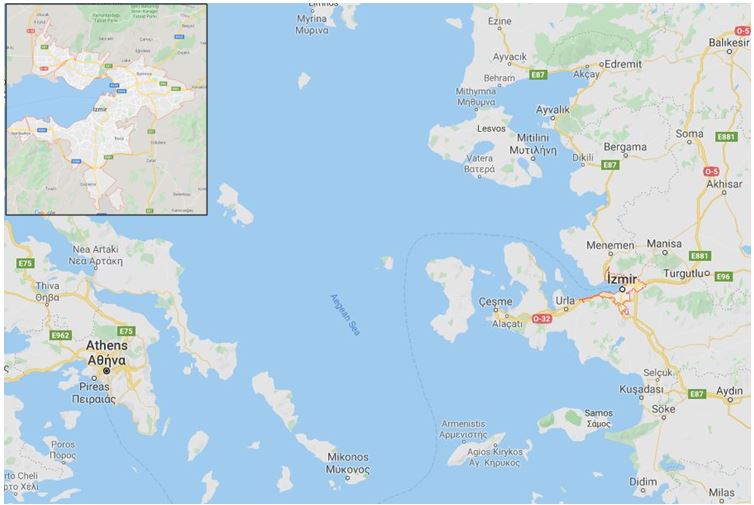
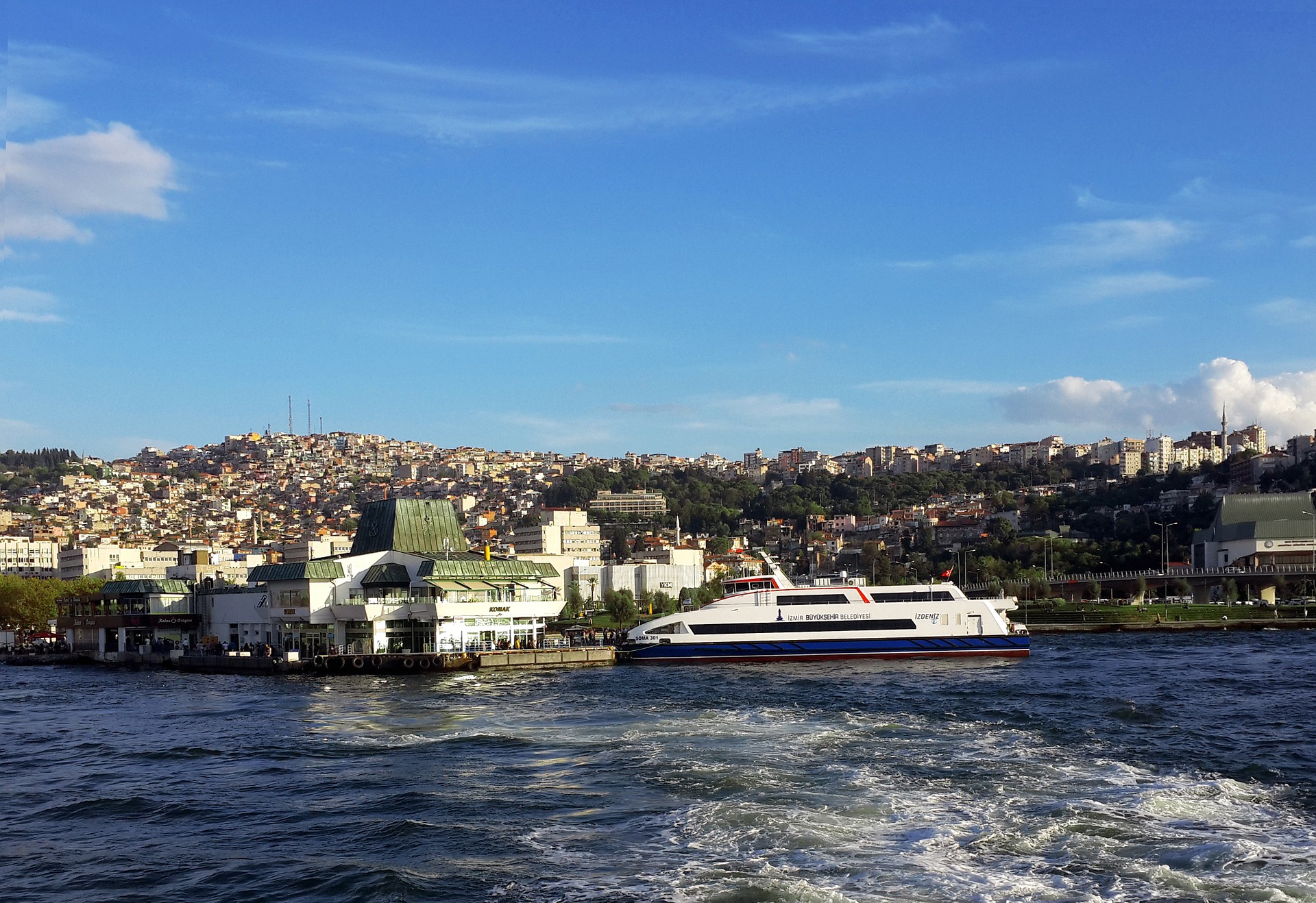
Izmir/Smyrna is the third largest city in Turkey with a population of around 4 million, the second biggest port after Istanbul, and a very good transport hub. The fact that almost half of its population of 4 million are under the age of 30, makes İzmir a city full of life. The city hosts tens of thousands of university students, educates scientists, artists, business leaders and academics. Several railroads follow the courses of the ancient routes into the distant interior. In its harbor ships from all parts of the world may be seen. The ancient harbor of Paul’s time has been filled in, and there the modern bazaars stand. The old stadium has been destroyed to make room for modern buildings, and a large part of the ancient city lies buried beneath the modern houses and many mosques of which the city boasts. The better of the modern buildings, belonging to the government and occupied by the foreign consuls, stand along the modern quay. Traces of the ancient walls are still to be found. West of Mt. Pagus is the Ephesian gate, and the Black-gate, as the Turks call it, is near the railroad station. The castle upon Mt. Pagus, 460 ft. above the sea, dates from Byzantine times. The prosperity of Smyrna is due, not only to the harbor and the port of entry to the interior, but partly to the perfect climate of spring and autumn – the winters are cold and the summers are hot; and also to the fertility of the surrounding country. Figs, grapes, valonia, opium, sponges, cotton and licorice root are among the chief articles of trade. International Standard Bible Encyclopedia, Wiki Travel
Getting to Know Him
Do you want eternal life? Do you want to enter heaven through the only guide that can help you navigate your way there? To enter His home, get to know Him better, and make Him your Lord and Savior CLICK HERE…..
Citations:
Esword
“Sword: Free Bible Study for the PC.” International Standard Bible Encyclopedia, Cyclopedia of Biblical, Theological and Ecclesiastical Literature, e-sword.net/.
Bible Gateway
“BibleGateway.” BibleGateway.com: A Searchable Online Bible in over 150 Versions and 50 Languages., http://www.biblegateway.com/.
The life of John the son of Zebedee may be summarized in the following sequence. He was a convert of John the Baptist and spent some time with the proclaimer of the new covenant in the Jordan Valley. It was here that he met Jesus and transferred his allegiance from John to Jesus (John 1:19-42). Some time after this, when John and his brother James had resumed fishing, they again encountered Jesus by the Sea of Galilee and at once decided to….>>>>> MORE
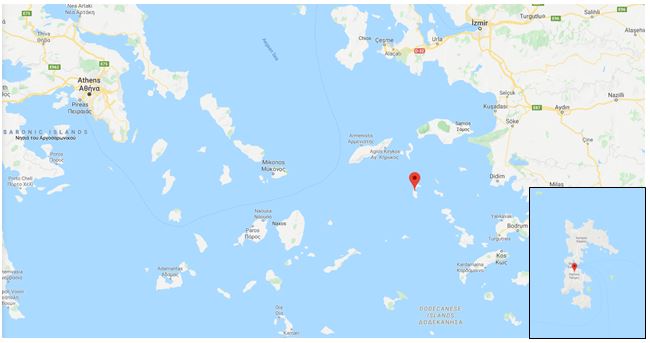
A small rocky and barren island, one of the group called the “Sporades,” in the Aegean Sea. It is mentioned in Scripture only in Rev_1:9. It was on this island, to which John was banished by the emperor Domitian (A.D. 95), that he received from God the wondrous revelation recorded in his book. This has naturally invested it with the deepest interest for all time. It is now called Patmo.
Dear Heavenly Father, thank you for the direction that You have given me, please help me to understand all that You have had written down so that in every circumstance I will be ready with the knowledge that You provide. In Jesus Name Amen
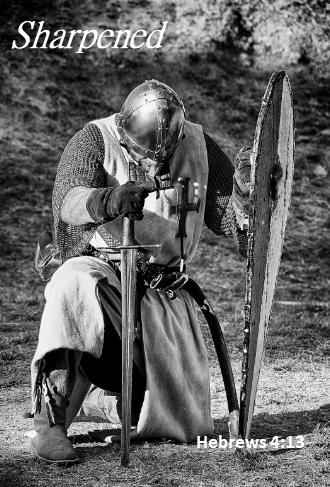
For the word of God is living and active, sharper than any two-edged sword, piercing to the division of soul and of spirit, of joints and of marrow, and discerning the thoughts and intentions of the heart. Hebrews 4:13 (ESV)
Getting to Know Him
Do you want eternal life? Do you want to enter heaven through the only guide that can help you navigate your way there? To enter His home, get to know Him better, and make Him your Lord and Savior CLICK HERE…..
Citation:
Open bible info Editor: Stephen Smith. Publication date: Apr 10, 2020. Publisher: OpenBible.info.
Dear Heavenly Father, Lord give me the understanding to be able to comprehend all that You have for me. Lord may my ears always be open to all that You have for me. The knowledge that You share with me is undeniably and unexplainedly the best most informative I could ask for, thank you. In Jesus Name Amen
Hear, for I will speak noble things, and from my lips will come what is right, for my mouth will utter truth; wickedness is an abomination to my lips. All the words of my mouth are righteous; there is nothing twisted or crooked in them. They are all straight to him who understands, and right to those who find knowledge. Take my instruction instead of silver, and knowledge rather than choice gold, Proverbs 8:6-10
1.
a. To recall to the mind with effort; think of again
b. To have (something) arise in one’s memory; become aware of (something) suddenly or spontaneously
2. To retain in the memory
3. To keep (someone) in mind as worthy of consideration or recognition.
4. To reward with a gift or tip
5. Engineering To return to (an original shape or form) after being deformed or altered.
Remember:
1. To have in the mind an idea which had been in the mind before, and which recurs to the mind without effort.
We are said to remember any thing, when the idea of it arises in the mind with the consciousness that we have had this idea before.
2. When we use effort to recall an idea, we are said to recollect it. This distinction is not always observed. Hence remember is often used as synonymous with recollect, that is, to call to mind. We say, we cannot remember a fact, when we mean, we cannot recollect it.
Remember the days of old. Deu 32.
3. To bear or keep in mind; to attend to.
Remember what I warn thee; shun to taste.
4. To preserve the memory of; to preserve from being forgotten.
Let them have their wages duly paid, and something over to remember me.
5. To mention. [Not in use.]
6. To put in mind; to remind; as, to remember one of his duty. [Not in use.]
7. To think of and consider; to meditate. Psa 63.
8. To bear in mind with esteem; or to reward. Eccl 9.
9. To bear in mind with praise or admiration; to celebrate. 1 Chr 16.
10. To bear in mind with favor, care, and regard for the safety or deliverance of any one. Psa 74. Gen 8. Gen 19.
11. To bear in mind with intent to reward or punish. 3 John 10. Jer 31.
12. To bear in mind with confidence; to trust in. Psa 20.
13. To bear in mind with the purpose of assisting or relieving. Gal 2.
14. To bear in mind with reverence; to obey.
Remember thy Creator in the days of thy youth. Eccl 12.
15. To bear in mind with regard; to keep as sacred; to observe.
Remember the sabbath day, to keep it holy. Exo 20.
Dear Heavenly Father, as I get to know You more Lord, I am amazed the love that You have for me. Please soften my heart and please allow the Holy Spirit to guide me and help me understand everything that You have in these words. Show me how to apply this message in my life. In Jesus Name Amen
Nicolaitans:
nik-ṓ-lā´i-tanz Νικολαΐταί, Nikolaitaı́
A sect or party of evil influence in early Christianity, especially in the 7 churches of Asia. Their doctrine was similar to that of Balaam, “who taught Balak to cast a stumbling block before the children of Israel, to eat things sacrificed to idols, and to commit fornication” (Rev_2:14-15). Their practices were strongly condemned by John, who praised the church in Ephesus for “hating their works” (Rev_2:6), and blamed the church in Pergamum for accepting in some measure their teaching (Rev_2:15). Except that reference is probably made to their influence in the church at Thyatira also, where their leader was “the woman Jezebel, who calleth herself a prophetess” (Rev_2:20; compare Rev_2:14), no further direct information regarding them is given in Scripture.
Reference to them is frequent in post-apostolic literature. According to Irenaeus (Adv. Haer., i. 26, 3; iii. 10, 7), followed by Hippolytus (Philos., vii. 36), they were founded by Nicolaus, the proselyte of Antioch, who was one of the seven chosen to serve at the tables (Act_6:5). Irenaeus, as also Clement of Alexandria (Strom., ii. 20), Tertullian and others, unite in condemning their practices in terms similar to those of John; and reference is also made to their Gnostic tendencies. In explanation of the apparent incongruity of such an immoral sect being founded by one of “good report, full of the Spirit and of wisdom” (compare Act_6:3), Simcox argues that their lapse may have been due to reaction from original principles of a too rigid asceticism. A theory, started in comparatively modern times, and based in part on the similarity of meaning of the Greek “Nikolaus,” and the Hebrew “Balaam,” puts forward the view that the two sects referred to under these names were in reality identical. Yet if this were so, it would not have been necessary for John to designate them separately.
The problem underlying the Nicolaitan controversy, though so little direct mention is made of it in Scripture, was in reality most important, and concerned the whole relation of Christianity to paganism and its usages. The Nicolaitans disobeyed the command issued to the Gentile churches, by the apostolic council held at Jerusalem in 49-50 AD, that they should refrain from the eating of “things sacrificed to idols” (Act_15:29). Such a restriction, though seemingly hard, in that it prevented the Christian communities from joining in public festivals, and so brought upon them suspicion and dislike, was yet necessary to prevent a return to a pagan laxity of morals. To this danger the Nicolaitans were themselves a glaring witness, and therefore John was justified in condemning them. In writing to the Corinthians, Paul gives warning against the same evil practices, basing his arguments on consideration for the weaker brethren (compare 1Co_8:1-13).
The Jerusalem council (Act_15:20; Act_15:29), while releasing Gentile converts from legalism, required their abstinence from idol meats and associated fornication. The Nicolaitans abused Paul’s doctrine of the grace of God into lasciviousness; such seducers are described as followers of Balsam, also in 2Pe_2:12-19; Jude_1 (“the son of Bosor” for Beor, to characterize him as “son of carnality”: bosor “flesh”). They persuaded many to escape obloquy by yielding as to “eating idol meats,” which was then a test of faithfulness (compare 1 Corinthians 8 and 1Co_10:25-33); they even joined in the “fornication” of the idol feasts, as though permitted by Christ’s “law of liberty.” The “lovefeasts” (Jud_1:12) thus became pagan orgies. The Nicolaitans combined evil “deeds” which Jesus “hates” with evil “doctrine.”
There are separate opinions of who the Angels of the Seven Churches were I will provide the differing explanations A&B.
A Angels of the Seven Churches
It is evident from the contexts of the various Biblical passages in which the word “angel” appears, that the word does not always represent the same idea. In such passages as Dan_12:1 and Act_12:15 it would seem that the angel was generally regarded as a superhuman being whose duty it was to guard a nation or an individual. However, in Mal_2:7 and Mal_3:1 (Hebrew) the word is clearly used to represent men. In the New Testament also, there are passages, such as Jas_2:25 (Greek), in which the word seems to be applied to men. The seven angels of the seven churches (Rev_1:20) received seven letters, figurative letters, and therefore it would seem that the seven angels are also figurative and may refer to the seven bishops who presided over the seven churches of Asia. Or the angels may be regarded as the personifications of the churches.
BANGELS OF THE SEVEN CHURCHES
1. According to one set of opinions, these angels were men, and the majority of writers have held them to be (1) the presiding presbyters or bishops of their respective churches. But while this view is attractive and popular, the reasons against it are strong. Human officials could hardly be made responsible for their churches as these angels are. A bishop might be called an angel, i.e. a messenger, of God or of Christ (cf. Hag_1:13, Mal_2:7, 2Co_5:20), but would he be called ‘the angel of the church’? Above all, it is certain that at the early date to which the Apocalypse is now generally assigned a settled episcopate was unknown. (2) Others have supposed that the angels were congregational representatives, church messengers or deputies (which would be in harmony with the proper meaning of the word ‘angel’), or even the person who acted as ‘Reader’ to the assembled church (notice ‘he that readeth’ in Rev_1:3). But if the responsibility put upon the angels is too great for bishops, it is much too great for any lesser functionaries. Besides, the glory and dignity assigned to them as the stars of the churches (Rev_1:20) is inconsistent with a position like that of a mere Reader or deputy.
2. A good many have held that ‘angels’ is to be understood in its ordinary Scriptural application, not to men, but to celestial beings. In support of this are—(1) the fact that throughout the rest of the book the Gr. word, which is of very frequent occurrence, is invariably used in this sense; (2) our Lord’s utterance in Mat_18:10, which suggests a doctrine of angelic guardianship; (3) the fact that in Daniel, to which the Apocalypse is so closely related, the guardianship of angels is extended to nations (Dan_12:1). The objections, however, are serious. No definite Scriptural teaching can be adduced in favor of the idea that churches have their guardian-angels. Messages intended for churches would hardly be addressed to celestial beings. Moreover, it is scarcely conceivable that such beings would be identified with particular churches in all their infidelities and shortcomings and transgressions, as these angels are (see, e.g., Dan_3:1; Dan_3:15 ).
3. The most probable view, accordingly, is that the angels are personifications of their churches—not actual persons either on earth or in heaven, but ideal representatives. It is the church, of course, that receives the letter, the ‘Thou’ of address having manifestly a collective force, and it is to the church itself that the letter is sent (cf. Rev_1:11, where there is no mention of the angels). The idea of angels was suggested, no doubt, by the later Jewish beliefs on the subject, but it is used in a figurative manner which suits the whole figurative treatment, where the glorified Jesus walks among the golden candlesticks, and sends to the churches messages that are couched in highly metaphorical language. It might seem to be against this ideal view that the seven churches, as candlesticks, are definitely distinguished from the seven angels, as stars (Rev_1:12; Rev_1:16; Rev_1:20). But it is quite in keeping with the inevitable distinction between an actual and an ideal church that they should be thus contrasted as a lamp and a star.
1. An affection of the mind excited by beauty and worth of any kind, or by the qualities of an object which communicate pleasure, sensual or intellectual. It is opposed to hatred. Love between the sexes, is a compound affection, consisting of esteem, benevolence, and animal desire. Love is excited by pleasing qualities of any kind, as by kindness, benevolence, charity, and by the qualities which render social intercourse agreeable. In the latter case, love is ardent friendship, or a strong attachment springing from good will and esteem, and the pleasure derived from the company, civilities and kindness of others.
Between certain natural relatives, love seems to be in some cases instinctive. Such is the love of a mother for her child, which manifests itself toward an infant, before any particular qualities in the child are unfolded. This affection is apparently as strong in irrational animals as in human beings.
We speak of the love of amusements, the love of books, the love of money, and the love of whatever contributes to our pleasure or supposed profit.
The love of God is the first duty of man, and this springs from just views of his attributes or excellencies of character, which afford the highest delight to the sanctified heart. Esteem and reverence constitute ingredients in this affection, and a fear of offending him is its inseparable effect.
2. Courtship; chiefly in the phrase, to make love, that is, to court; to woo; to solicit union in marriage.
3. Patriotism; the attachment one has to his native land; as the love of country.
4. Benevolence; good will.
1. Having the strength much exhausted by toil or violent exertion; tired; fatigued. [It should be observed however that this word expresses less than tired, particularly when applied to a beast; as a tired horse. It is followed by of, before the cause of fatigue; as, to be weary of marching; to be weary of reaping; to be weary of study.]
2. Having the patience exhausted, or the mind yielding to discouragement. He was weary of asking for redress.
3. Causing weariness; tiresome; as a weary way; a weary life.
to deceive.
1. Not true; not conformable to fact; expressing what is contrary to that which exists, is done, said or thought. A false report communicates what is not done or said. A false accusation imputes to a person what he has not done or said. A false witness testifies what is not true. A false opinion is not according to truth or fact. The word is applicable to any subject, physical or moral.
2. Not well founded; as a false claim.
3. Not true; not according to the lawful standard; as a false weight or measure.
4. Substituted for another; succedaneous; supposititious; as a false bottom.
5. Counterfeit; forged; not genuine; as false coin; a false bill or note.
6. Not solid or sound; deceiving expectations; as a false foundation
False and slippery ground.
7. Not agreeable to rule or propriety; as false construction in language.
8. Not honest or just; not fair; as false play.
9. Not faithful or loyal; treacherous; perfidious; deceitful. The king’s subjects may prove false to him. So we say, a false heart.
10. Unfaithful; inconstant; as a false friend; a false lover; false to promises and vows.
The husband and wife proved false to each other.
11. Deceitful; treacherous; betraying secrets.
12. Counterfeit; not genuine or real; as a false diamond.
13. Hypocritical; feigned; made or assumed for the purpose of deception; as false tears; false modesty. The man appears in false colors. The advocate gave the subject a false coloring.






























 Dear Heavenly Father, Lord give me the






 Love:
Love:





 Drink of Jesus
You must be logged in to post a comment.